JinAD 266–420
Baopuzi
320
Ge Hong wrote this influential work on Daoism and society.
View on the timeline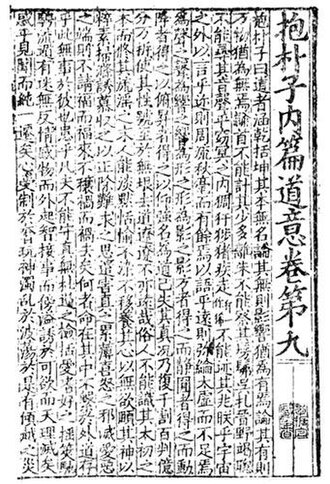
Image: Ge Hong · Public domain · Original
The Baopuzi is a major work by Ge Hong, a fourth-century scholar and Daoist writer living during the transition from the Western to the Eastern Jin. It is conventionally divided into Inner Chapters and Outer Chapters. The Inner Chapters discuss immortals, alchemy, longevity, spirits, and religious cultivation; the Outer Chapters focus more on Confucian ethics, politics, social behavior, and the scholar’s place in public life. Together they reveal Ge Hong’s attempt to defend the possibility of transcendence while engaging with the moral and political concerns of educated elites. The alchemical sections describe minerals, furnaces, ingredients, and procedures, making the work an important source for the history of Daoist practice and early material knowledge. These descriptions should not be equated with modern chemistry or medical science. The Outer Chapters use argument and dialogue to consider reputation, ambition, withdrawal, and good government. The received book has a complex transmission history, and its two parts have distinct emphases. Reading it requires separating religious claims, philosophical reasoning, and technical observations rather than accepting or dismissing the work as a single undifferentiated system.
References
Text and images from Wikipedia are used under CC BY-SA and their respective licenses