JinAD 266–420
Western Jin Falls; Eastern Jin Founded
AD 316–317
In AD 316 the Xiongnu state of Former Zhao took Chang'an and the Western Jin fell; in 317 Sima Rui restored the Jin at Jiankang as the Eastern Jin, with “Wang and Sima sharing the realm.”
View on the timeline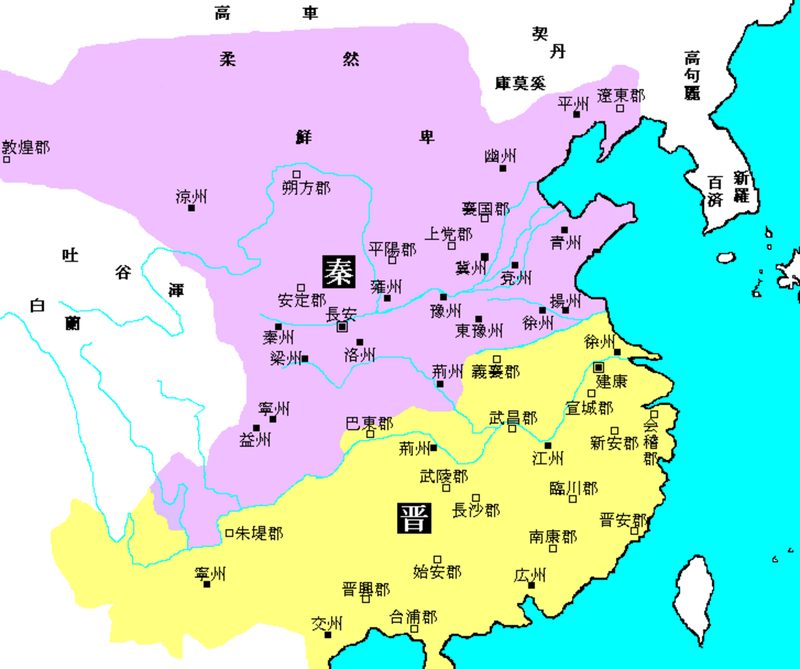
After the War of the Eight Princes, Western Jin strength was badly weakened and the chiefs of the inward-moving peoples rose in turn. The Xiongnu noble Liu Yuan founded the state of Han in AD 304; after his son Liu Cong took the throne, he sent troops in 311 to take Luoyang and capture Emperor Huai of Jin, known as the “Disaster of Yongjia.” In 316 Liu Cong's general Liu Yao took Chang'an and Emperor Min of Jin surrendered, ending the Western Jin. Northern gentry and commoners then moved south in great numbers, the “crossing of the gentry to the south.” At that time Sima Rui, Prince of Langye, a Western Jin royal who held the lower Yangtze, was building his base around Jiankang (present-day Nanjing, Jiangsu); in 317 he took the title King of Jin and in 318 formally became emperor, restoring the Jin with Jiankang as capital, called the Eastern Jin, and Sima Rui was Emperor Yuan of Jin. With no roots in Jiangnan, Sima Rui owed his throne to northern and southern great clans led by Wang Dao, whom he relied on in government, with Wang Dao's cousin Wang Dun in military affairs. People of the time called this “Wang and Sima share the realm.” The Eastern Jin was the age of greatest power for the aristocratic clans; the Wang of Langye and Xie of Chen Commandery held power in turn and imperial power was weak. Northern expeditions by Zu Ti, Huan Wen and others briefly recovered some land south of the Yellow River, but the court distrusted and obstructed the commanders, and the Central Plains were never regained. The Eastern Jin held on in Jiangnan for over a hundred years, successfully resisted the Former Qin at the Battle of Fei River, and kept the south stable, creating favorable conditions for developing Jiangnan. In 420 it was replaced by the Song founded by Liu Yu.
References
Text and images from Wikipedia are used under CC BY-SA and their respective licenses