JinAD 266–420
Zu Ti's Northern Expedition
AD 313
Known for “rising at cockcrow to practice sword,” Zu Ti crossed the Yangtze in AD 313, vowed while striking his oar mid-river, and recovered much land south of the Yellow River.
View on the timeline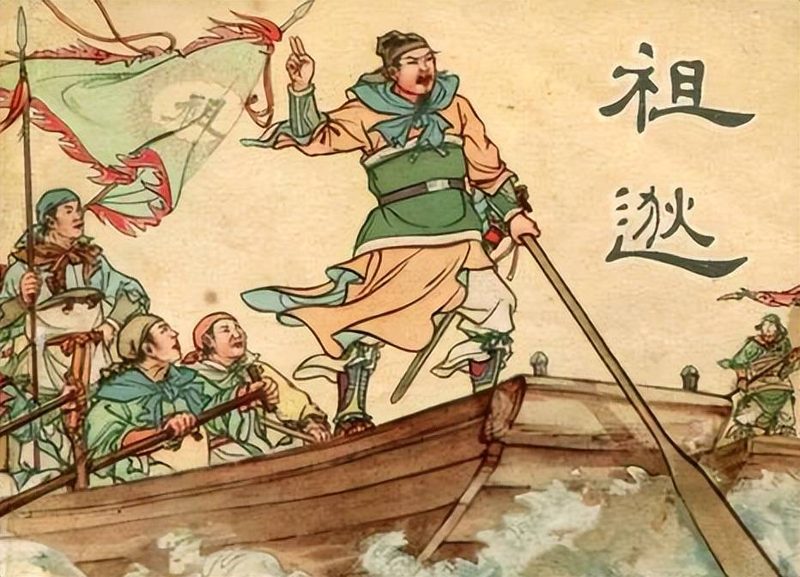
At the end of the Western Jin, many northerners moved south hoping the Jin could retake the Central Plains; a leading figure among them was Zu Ti. Zu Ti, courtesy name Shizhi, from Qiu county in Fanyang (present-day Laishui, Hebei), had great ambition in youth; with his friend Liu Kun he rose at midnight at the crowing of the cock to practice with the sword, determined to serve the country, the origin of the idiom “rising at cockcrow to practice sword.” Before the Western Jin fell, Zu Ti led several hundred households south to the Huai and Yangtze region. He repeatedly asked Sima Rui, Prince of Langye, who held Jiankang, to send troops north to recover the Central Plains. Sima Rui, wanting only to hold Jiangnan, made him Governor of Yu Province but gave only provisions for a thousand men and three thousand bolts of cloth, telling him to recruit his own army. In 313 Zu Ti led over a hundred households of his followers across the river northward. Midway, standing in the bow and striking his oar, he swore passionately: “If I, Zu Ti, cannot clear the Central Plains and cross this river again, may I be like this great river that flows away and never returns!” Those with him were moved, the origin of the allusion “striking the oar in mid-stream.” After crossing, he smelted iron and cast weapons around Huaiyin and raised a force of over two thousand. After years of hard fighting he defeated Shi Le of the Later Zhao, recovered most of the land south of the Yellow River, and stopped Later Zhao raids south. But the court distrusted him and sent Dai Yuan to check him, and amid the conflict between Wang Dun and Sima Rui, Zu Ti fell ill from frustration and died at Yongqiu in 321. After his death the lands were gradually lost.
References
Text and images from Wikipedia are used under CC BY-SA and their respective licenses