JinAD 266–420
Northern Peoples Move Inward; the Sixteen Kingdoms
Early 4th century–early 5th century
Nomadic peoples of the north moved inward through the Han, Wei and Jin; at the end of the Western Jin, Xiongnu, Xianbei, Jie, Di and Qiang leaders founded states, the “Sixteen Kingdoms.”
View on the timeline
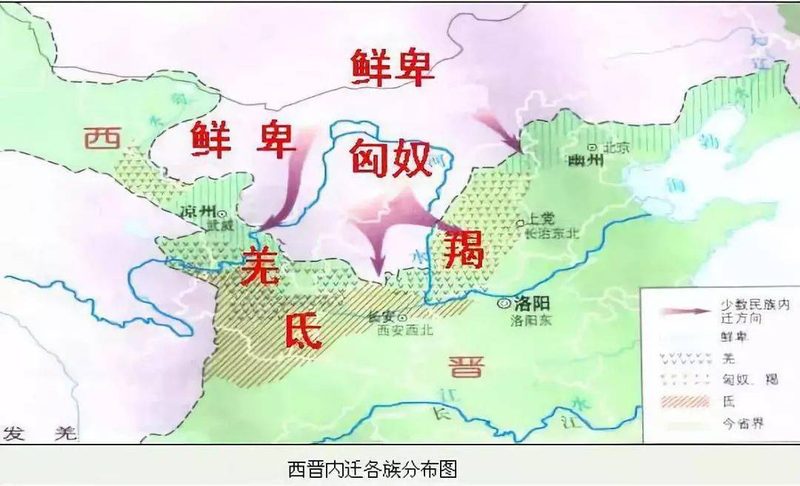
On the broad northern steppes of China lived nomadic peoples such as the Xiongnu, Xianbei, Jie, Di and Qiang, who followed water and grass. In the Eastern Han, Wei and Jin, Central Plains dynasties admitted northern peoples in succession to add labor and soldiers. The Di and Qiang of the northwest moved into Guanzhong in Shaanxi; the Xiongnu and Jie of the Mongolian steppe moved south to Shanxi; some Xianbei moved to Liaoning and some to Shaanxi and the Ordos region. By the Western Jin, the inward-moving peoples made up about half the population of Guanzhong. They lived mixed with the Han and gradually took up farming, promoting ethnic fusion. But Western Jin rule was corrupt: it taxed them heavily, drafted them for soldiering and labor, and even seized and sold them as slaves, provoking fierce resistance. After the War of the Eight Princes their chiefs took the chance to rise. In 304 the Xiongnu noble Liu Yuan rose and founded a state called Han (later renamed Zhao, known as the Former Zhao), which later took Luoyang and Chang'an and destroyed the Western Jin. From 304 until the Northern Wei reunified the north in 439, over twenty regimes appeared in the north, sixteen of them major, hence the “Sixteen Kingdoms.” The north saw frequent war and constant turnover of regimes, and the economy was badly damaged. Among them, Fu Jian of the Former Qin, employing the Han official Wang Meng for reforms, briefly unified the north but fell apart after defeat at the Battle of Fei River. In the Sixteen Kingdoms period, the regimes of the various peoples mostly adopted sinicizing measures and employed Han scholars, promoting ethnic fusion in the north and preparing the way for the Northern Wei's unification and the later Sui and Tang.
References
Text and images from Wikipedia are used under CC BY-SA and their respective licenses