Warring States475–221 BC
Kaogong Ji
300 BCE
Kaogongji records early Chinese crafts and techniques.
View on the timeline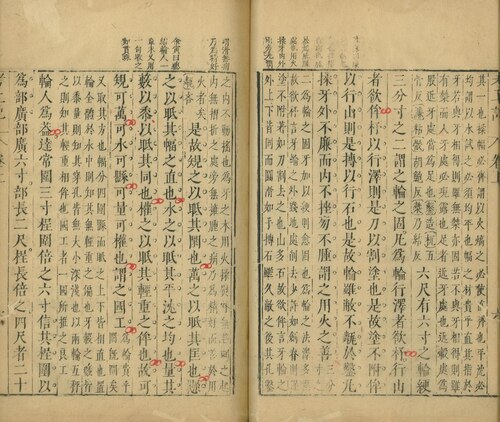
Public domain · Original
The Kaogong Ji, or Book of Artificers, is an early Chinese text on crafts and technical production that survives as part of the Rites of Zhou. It organizes knowledge by occupations and discusses woodworking, metalworking, leatherwork, dyeing, jade carving, pottery, and other trades. Its descriptions address materials, dimensions, procedures, and standards for objects such as vehicles, weapons, bells, and vessels. The work is valuable not only as a technical record but also for showing how craft production was connected to ritual hierarchy and state order. Its account of ideal city planning is often used in studies of ancient urban design, although the text cannot be assumed to describe one city exactly as built. The date and editorial history of the surviving chapters are debated, and the work may preserve material from different periods. Archaeologists therefore compare its prescriptions with excavated tools, workshops, buildings, and finished objects. The Kaogong Ji offers a rare view of early Chinese efforts to classify skilled labor and make production legible to government; it is not a universal handbook that every workshop followed uniformly.
References
Text and images from Wikipedia are used under CC BY-SA and their respective licenses