QingAD 1644–1912
Nian Rebellion
1851
The Nian Rebellion was a major Qing-era uprising.
View on the timeline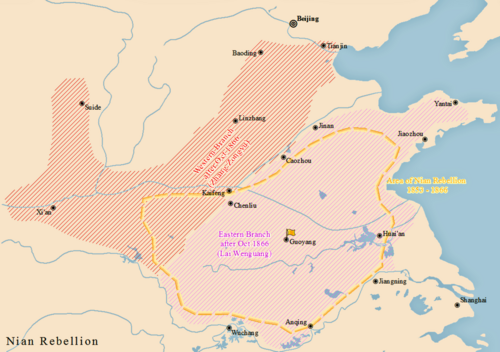
Image: SY · CC BY-SA 4.0 · Original
The Nian Rebellion was a mid-nineteenth-century armed movement centered on the Huai River region and the North China Plain, generally dated from the 1850s to 1868. “Nian” referred to bands or local associations, and participants included impoverished farmers, displaced people, armed brokers, and others; the movement was never a single army under continuous central command. Floods, land concentration, insecurity, and the disruption caused by the Taiping War created conditions in which armed groups could expand. Early bands operated independently, while leaders such as Zhang Lexing later encouraged alliances. Some Nian forces cooperated with the Taiping, and the movement persisted after the Taiping capital fell. Qing commanders, including Sengge Rinchen and Li Hongzhang, used blockades, defensive lines, and mobile pursuit to restrict Nian movements. By 1868 the principal forces had been defeated. Their cavalry-based mobility and local networks made them difficult to contain, but strategies and goals differed among bands and changed over time. The term “Nian Rebellion” covers several phases of conflict and should not be reduced to one uniform peasant movement.
References
Text and images from Wikipedia are used under CC BY-SA and their respective licenses