QingAD 1644–1912
Taiping Capital at Tianjing and the Land System
1853
In 1853 the Taipings took Nanjing and made it their capital, Tianjing, then issued the Land System of the Heavenly Dynasty, an ideal of shared land and food that was never put into practice.
View on the timeline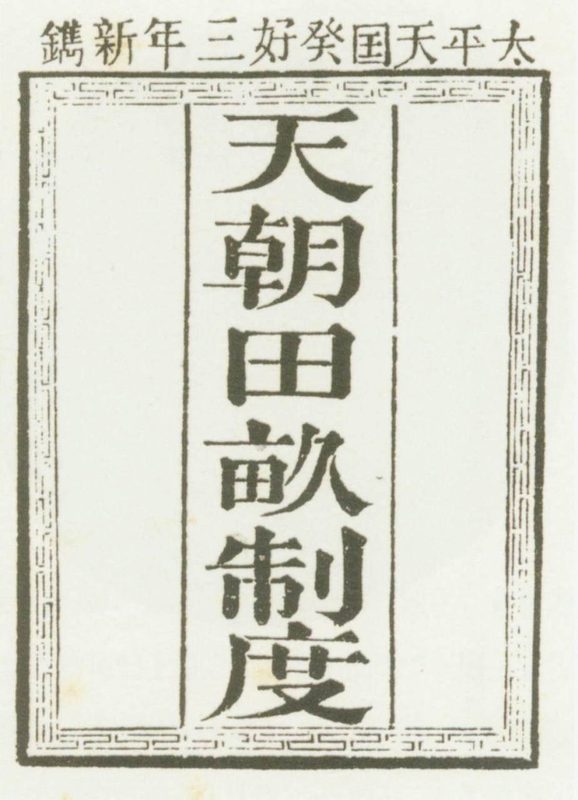
In spring 1852 the Taiping army broke out of Yong’an and marched north, besieging Guilin and Changsha. South King Feng Yunshan and West King Xiao Chaogui both died on the march. In January 1853 it took Wuchang, capital of Hubei, and grew to 500,000 men. It then left Wuchang and advanced east along the Yangtze by land and water, taking Jiujiang, Anqing, Wuhu and other places, and in March 1853 captured Nanjing, renamed it Tianjing (Heavenly Capital) and made it the capital, formally establishing a peasant regime facing the Qing. There it issued the Land System of the Heavenly Dynasty, which divided land into nine grades by yield and distributed it equally by population and age regardless of sex, with those over sixteen receiving a full share and those fifteen and under half. Every twenty-five families formed a unit with a public treasury and a worship hall, and each household kept only the grain it needed and handed the rest to the treasury. It set out an ideal society in which “land is farmed together, food is eaten together, clothes are worn together, money is spent together, everything is evenly shared, and no one lacks food or warmth.” The system reflected the peasants’ strong wish to abolish feudal land ownership and gain land, and served as a programmatic document of anti-feudal struggle, but its strong absolute egalitarianism was divorced from reality and could not be carried out. In practice the Taiping in its territory kept the policy of “paying grain and taxes as before.” It also sent northern and western expeditions: the northern force pushed deep alone, came close to Tianjin and ultimately failed, while the western force won great victories and took much of the middle Yangtze.
References
Text and images from Wikipedia are used under CC BY-SA and their respective licenses