QingAD 1644–1912
The Second Opium War and the Treaties of Tianjin
1856–1858
Using the Arrow incident and a French priest’s killing as pretexts, Britain and France began the Second Opium War in 1856, took the Dagu forts in 1858 and forced the Treaties of Tianjin on the Qing.
View on the timeline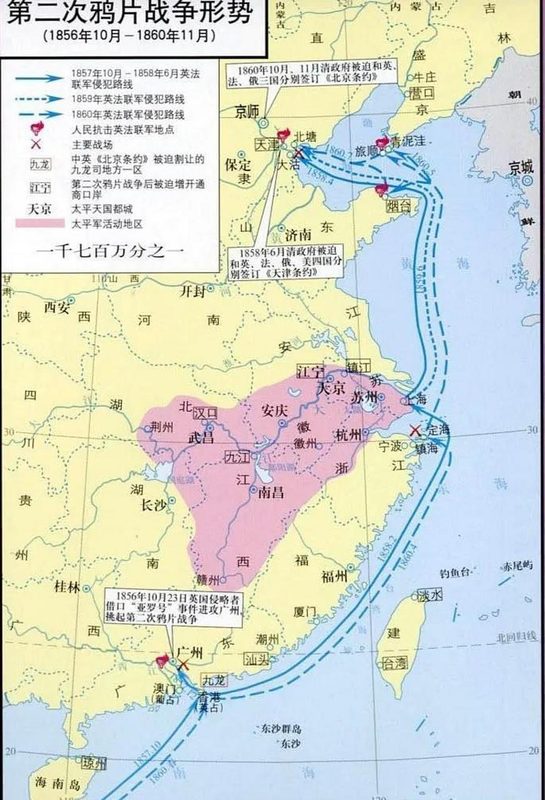
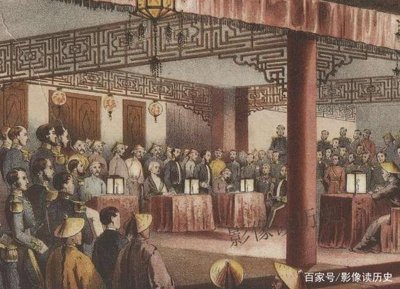
After the Opium War the Western powers, not satisfied with their gains, sought to open the Chinese market further and widen their privileges. In 1854 Britain, France and the US demanded “treaty revision,” which the Qing refused. In October 1856 Britain used the “Arrow incident” as a pretext to attack Guangzhou. The Arrow was a Chinese-owned ship that had once been registered in Hong Kong but whose license had expired; Guangdong naval forces boarded it to arrest pirates, and the British consul Harry Parkes falsely claimed Chinese soldiers had pulled down the British flag. France used as its pretext the execution in Xilin County, Guangxi, of the French priest Auguste Chapdelaine for illegal preaching, and joined Britain; the Second Opium War began. At the end of 1857 the Anglo-French force took Guangzhou and captured Governor-General Ye Mingchen. In 1858 it went north, took the Dagu forts at Tianjin and threatened Beijing. The Qing sent Grand Secretary Guiliang and others to sign separate Treaties of Tianjin with Britain, France, Russia and the US. They provided for foreign ministers to reside in Beijing; ten more treaty ports including Niuzhuang, Dengzhou, Tainan, Tamsui, Hankou, Jiujiang, Nanjing and Zhenjiang; free navigation on the Yangtze for foreign merchant ships and warships; the right of foreigners to travel, trade and preach inland; and indemnities of four million taels of silver to Britain and two million to France. Trade regulations signed in Shanghai that year also legalized the opium trade. The Treaties of Tianjin cost China further sovereignty and carried foreign influence from the coast into the interior.
References
Text and images from Wikipedia are used under CC BY-SA and their respective licenses