People's Republic of China1949–present
Yangtze River Crossing Campaign and Liberation of Nanjing
April 1949
On 21 April 1949 a million Liberation Army troops crossed the Yangtze, and on 23 April they took Nanjing, marking the collapse of Kuomintang rule on the mainland.
View on the timeline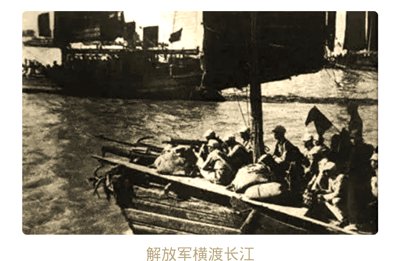
After the three great campaigns the Kuomintang's main military force had largely been destroyed. To gain time and rebuild its army, Chiang Kai-shek announced his "retirement" in January 1949, and Vice President Li Zongren became acting president and entered peace talks with the Communist Party, hoping to "divide China at the Yangtze." In April 1949 delegates of both sides held talks in Beiping, but the Nanjing National Government refused to sign the peace agreement and the talks broke down. On 21 April Mao Zedong and Zhu De issued the Order to the Army for a Nationwide Advance. One million men of the Second and Third Field Armies, along a front of over 500 kilometers from Hukou in Jiangxi in the west to Jiangyin in Jiangsu in the east, crossed the Yangtze in three columns and quickly broke through the river defenses the Kuomintang had labored to build. The Kuomintang Navy's Second Coastal Defense Fleet rose in revolt near Nanjing. On 23 April the Liberation Army occupied Nanjing, the center of Kuomintang rule, and the Kuomintang government moved to Guangzhou, marking the collapse of its rule on the mainland. On hearing the news, Mao wrote the famous lines "Wind and rain sweep over Zhongshan Mountain, a million brave troops cross the great river," and "We should pursue the retreating enemy with all our remaining strength, and not seek vain fame like the overlord of Chu." The Liberation Army then pressed on, liberating Hangzhou, Wuhan and Shanghai in May, while the Fourth and First Field Armies advanced into Central-South and Northwest China; by 1950 the whole mainland except for Taiwan and some islands was largely liberated. The Memorial Hall of the Yangtze Crossing Victory in Nanjing, Jiangsu, presents this history.
References
Text and images from Wikipedia are used under CC BY-SA and their respective licenses