Republic of ChinaAD 1912–1949
Southern Anhui Incident
January 1941
In January 1941 Kuomintang hardliners ambushed and destroyed the New Fourth Army headquarters and its southern Anhui units at Maolin; Ye Ting was detained and Xiang Ying killed.
View on the timeline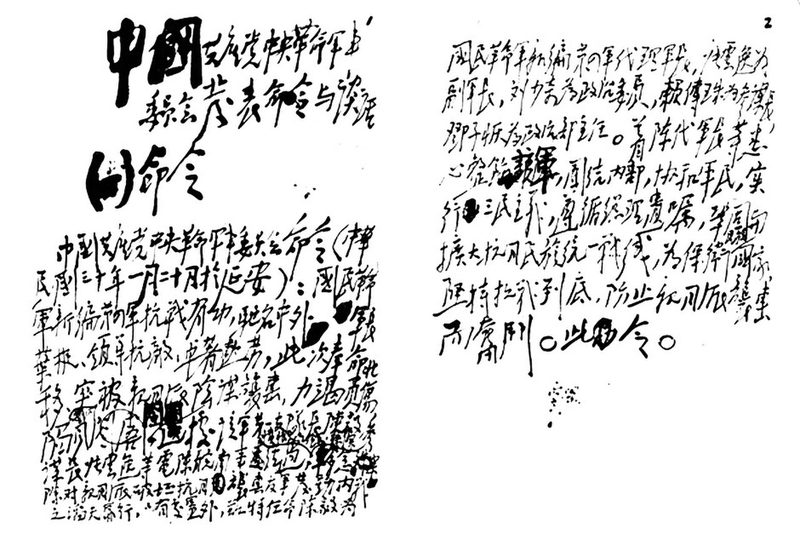
After the War of Resistance entered its stalemate phase, the Kuomintang's policy focus shifted from resisting Japan abroad to opposing the Communists at home, and its hardliners repeatedly stirred up anti-Communist "frictions." In October 1940, He Yingqin, chief of the General Staff of the National Government's Military Affairs Commission, and Bai Chongxi, its deputy chief, issued the "Hao telegram," ordering the Eighth Route Army and New Fourth Army south of the Yellow River to withdraw northward. For the sake of the overall anti-Japanese cause, the Communist Party agreed to move the New Fourth Army in southern Anhui north of the Yangtze River. On 4 January 1941 the New Fourth Army headquarters and its southern Anhui units, over 9,000 men, set out northward as ordered. On 6 January, as they reached Maolin in Jing County, Anhui, they were ambushed by 80,000 Kuomintang troops in seven divisions. The New Fourth Army fought for seven days and nights, but, hopelessly outnumbered and out of ammunition and food, all but about 2,000 who broke out were killed or captured. Commander Ye Ting was detained while negotiating with the Kuomintang, and deputy commander Xiang Ying was killed during the breakout. On 17 January Chiang Kai-shek falsely branded the New Fourth Army a "mutinous army" and announced the abolition of its designation. This was the Southern Anhui Incident, which shocked China and the world during the second anti-Communist upsurge. Zhou Enlai wrote in the Xinhua Daily: "The most unjust wrong of all time, a single leaf in Jiangnan; kin turning weapons on kin, why such haste to destroy each other?" On 20 January the Central Military Commission of the Chinese Communist Party ordered the reconstruction of the New Fourth Army headquarters, appointing Chen Yi acting commander and Liu Shaoqi political commissar. Holding to the principles of being justified, advantageous and restrained, the Party both beat back the anti-Communist upsurge and preserved the anti-Japanese national united front. In 1946, soon after his release, Ye Ting died in a plane crash on the way to Yan'an.
References
Text and images from Wikipedia are used under CC BY-SA and their respective licenses