Republic of ChinaAD 1912–1949
Mao Zedong Publishes On Protracted War
1938
In May 1938 Mao Zedong published On Protracted War, refuting “defeatism” and “quick victory” theories and arguing that the war would be protracted and victory would belong to China.
View on the timeline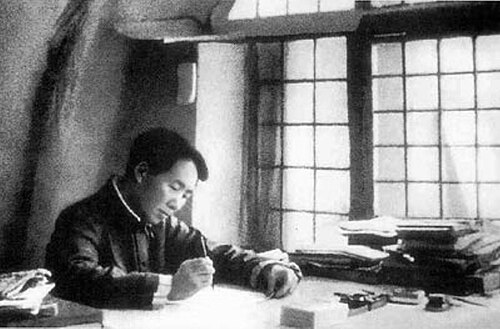
After the all-out resistance began, the Communist Party fully mobilized and relied on the masses and held to the line of total resistance. As Shanghai, Nanjing and other major cities fell one after another, a “theory of national subjugation” holding that China was bound to perish spread in the Kuomintang; after the victory at Taierzhuang, others promoted a “theory of quick victory”, holding that China could soon defeat Japan. To refute these mistaken views, in May–June 1938 Mao Zedong gave a long lecture at the Yan'an Anti-Japanese War Research Society, On Protracted War. Mao analyzed the basic features of both sides: Japan was a strong imperialist country, but its war was retrogressive and barbarous, its manpower and finances were insufficient, and it had little support; China was a weak semi-colonial, semi-feudal country, but lived in an age of progress, was large and rich in resources with many people and troops, and fought a just war that won much support. The War of Resistance would therefore be protracted, and final victory would belong to China. Mao predicted that it would pass through three stages, strategic defensive, strategic stalemate and strategic counter-offensive, the stalemate being the key stage in which China would turn from weak to strong and Japan from strong to weak. He also stated that “the richest source of the power to wage war lies in the masses of the people”, so a line of total resistance had to be followed, mobilizing the masses fully for a people's war. On Protracted War scientifically foresaw the course of the war, systematically set out the general strategy of protracted resistance, and was a programmatic document guiding the Chinese people to victory.
References
Text and images from Wikipedia are used under CC BY-SA and their respective licenses