Republic of ChinaAD 1912–1949
Huayuankou Dike Breach
June 1938
In June 1938, to halt the Japanese advance, the National Government breached the Yellow River dike at Huayuankou, slowing the Japanese but causing a vast disaster in the flooded zone.
View on the timeline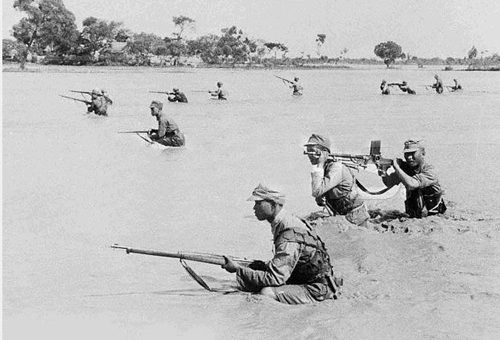
After Xuzhou fell in May 1938, Japanese troops advanced west along the Longhai Railway, took Kaifeng and approached Zhengzhou, intending to go south along the Beijing–Hankou Railway to attack Wuhan. To stop their advance west and south, Chiang Kai-shek ordered Kuomintang troops in Henan to breach the Yellow River dikes, using water in place of troops. In June 1938 Kuomintang troops first failed to breach the dike at Zhaokou in Zhongmu, then breached the south-bank dike at Huayuankou north of Zhengzhou. The Yellow River poured out and flooded southeast, flowing through the Jialu, Ying and other rivers into the Huai River and inundating large areas in 44 counties and cities of Henan, Anhui and Jiangsu. The flood temporarily checked the Japanese advance, forced them to abandon the plan of going south along the Beijing–Hankou line against Wuhan and to move west along the Yangtze instead, buying time for the Battle of Wuhan; but it brought deep suffering to the people. 9 million (figures vary). The Yellow River then flowed south by a new course for nine years, creating a large “Yellow River flooded zone” in eastern Henan, northern Anhui and northern Jiangsu, where land turned to sand and floods, droughts and locusts were frequent. The National Government afterwards claimed the breach was caused by Japanese bombing. After the war, with United Nations Relief and Rehabilitation Administration aid, work to close the breach began in 1946; the dike was closed in March 1947 and the river returned to its old course. The Huayuankou breach is a painful page of using water as a weapon in the war and remains disputed.
References
Text and images from Wikipedia are used under CC BY-SA and their respective licenses