Republic of ChinaAD 1912–1949
Nanjing Massacre
From 13 December 1937
After Japanese troops took Nanjing in December 1937, over six weeks they killed more than 300,000 Chinese civilians and disarmed soldiers in appalling atrocities.
View on the timeline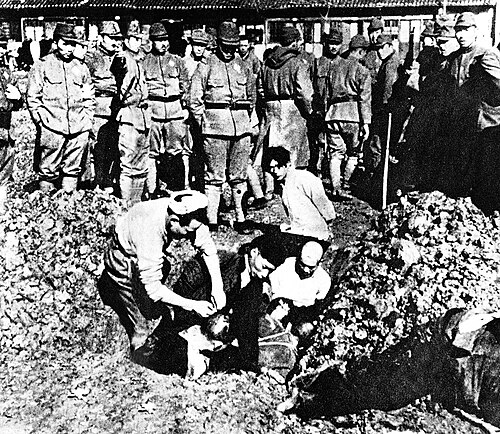
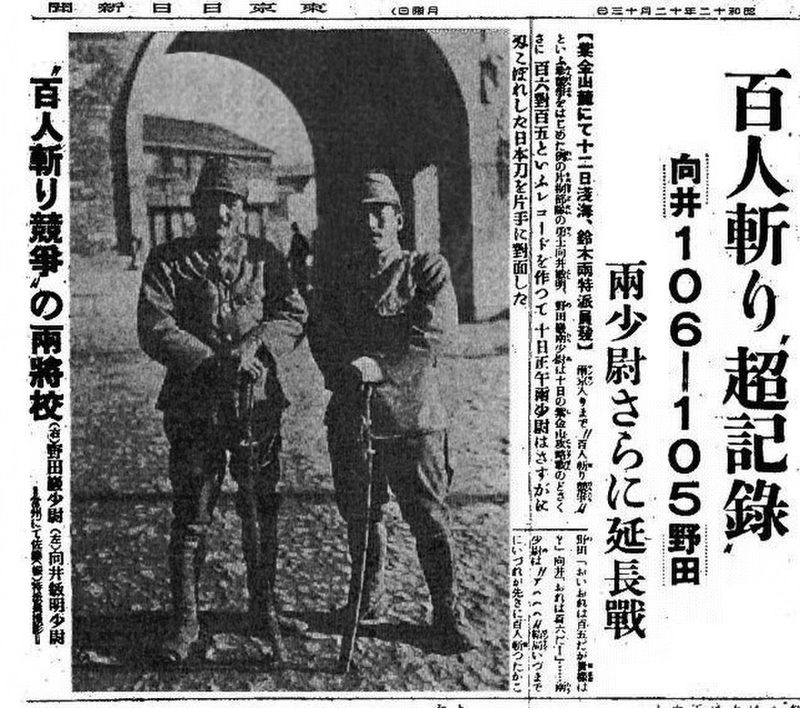
After the Battle of Shanghai, Japanese troops advanced on Nanjing in three columns. They took the city on 13 December 1937; the National Government had already announced the move of the capital to Chongqing, designated the wartime capital. After the occupation the Japanese army carried out a bloody massacre in and around the city lasting six weeks, killing Chinese civilians and disarmed soldiers by mass shooting, live burial, hacking and burning; the dead numbered over 300,000. Japanese troops also raped women on a massive scale, looted property and burned buildings. Japanese newspapers even openly reported a “killing contest” between two army second lieutenants. During the massacre more than a dozen foreigners who stayed in Nanjing, including the German John Rabe and the American Minnie Vautrin, organized the International Committee for the Nanjing Safety Zone, set up the Safety Zone and protected over 200,000 Chinese refugees. The American missionary John Magee filmed the Japanese atrocities, leaving valuable historical evidence. The Nanjing Massacre was one of the gravest crimes committed by Japan in its war of aggression against China and an appalling atrocity in the history of human civilization. After the war, the International Military Tribunal for the Far East and the Nanjing War Crimes Tribunal tried the main persons responsible, sentencing war criminals including Matsui Iwane and Tani Hisao to death. In 1985 the Memorial Hall of the Victims in Nanjing Massacre by Japanese Invaders opened. In 2014 the NPC Standing Committee designated 13 December each year as the National Memorial Day for Victims of the Nanjing Massacre. In 2015 the Nanjing Massacre Archives were inscribed in UNESCO's Memory of the World Register.
References
Text and images from Wikipedia are used under CC BY-SA and their respective licenses