Republic of ChinaAD 1912–1949
Four Crossings of the Chishui and Luding Bridge
1935
After Zunyi, Mao Zedong directed the Red Army across the Chishui four times, the Jinsha and Dadu rivers and Luding Bridge, and over snow mountains and grasslands, shaking off its pursuers.
View on the timeline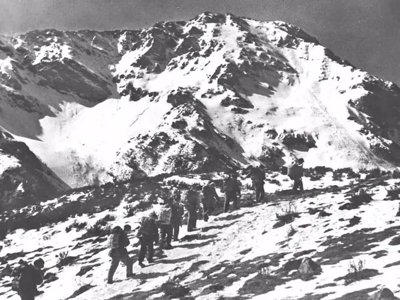
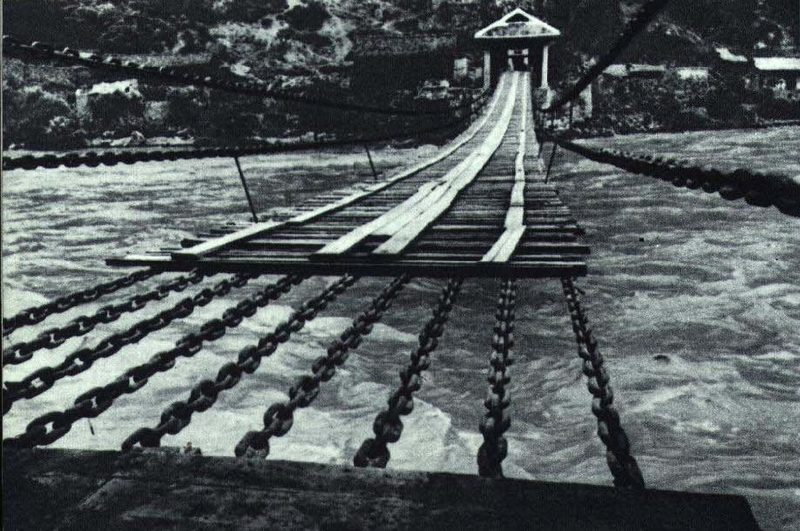
After the Zunyi Conference the Red Army was reorganized and its fighting power rose. From late January to late March 1935 Mao Zedong directed the Central Red Army around the Sichuan–Guizhou–Yunnan border, feinting east and striking west, crossing the Chishui four times, threatening Guiyang and Kunming, drawing in and destroying enemy troops on the move and upsetting the Kuomintang's pursuit plans. In early May the Red Army skillfully crossed the Jinsha River (upper Yangtze), escaping encirclement by hundreds of thousands of enemy troops. In late May it reached Anshunchang on the Dadu River, where seventeen heroes crossed in a small boat and forced the river. With too few boats for the main force, the Red Army marched hard along the west bank, covering 120 kilometers in a day and a night to reach Luding Bridge. The bridge was formed of thirteen iron chains, its planks removed by the enemy, and twenty-two assault troops climbed along the chains under fire to the far bank and took the bridge. In June the Red Army crossed the perpetually snow-covered Jiajin Mountain and joined the Fourth Front Army at Mougong. Zhang Guotao then opposed the Central Committee's northward course, and the Central Committee led the First and Third Army Groups north. In August the Red Army entered the vast grasslands, where many soldiers gave their lives; it came out through extraordinary endurance and in September broke through the natural barrier of Lazikou. On the Long March the Red Army crossed eighteen mountain ranges, five of them perpetually snow-capped, and twenty-four rivers, achieving a miracle in human history. Mao wrote the poem “The Long March”: “The Red Army fears not the trials of the distant march; to them the thousand mountains and rivers are nothing.”
References
Text and images from Wikipedia are used under CC BY-SA and their respective licenses