Republic of ChinaAD 1912–1949
Kuomintang First Congress and First United Front
January 1924
In January 1924 the Kuomintang First Congress effectively set the policies of allying with Russia and the Communists and aiding workers and peasants, forming the First United Front.
View on the timeline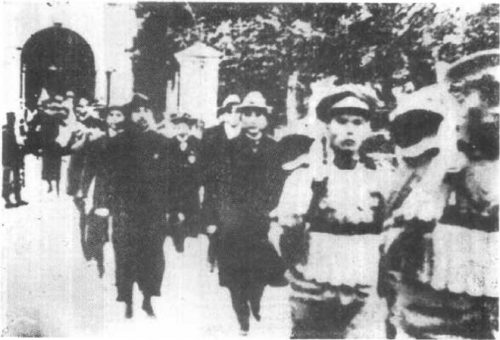
After the February 7 Massacre the Communist Party realized that defeating a powerful enemy required a broad revolutionary united front. Sun Yat-sen, after repeated setbacks, had also concluded that relying on warlords for revolution would not work; he resolved to seek a new path and received help from Soviet Russia and the Communists. In June 1923 the Party held its Third National Congress in Guangzhou and formally decided to cooperate with the Kuomintang led by Sun in a revolutionary united front, with Communists joining the Kuomintang as individuals while keeping the Party's political, ideological and organizational independence. In January 1924 the Kuomintang's First National Congress met in Guangzhou, attended by Communists including Li Dazhao, Mao Zedong and Lin Boqu. The manifesto it adopted gave the Three Principles of the People a new interpretation: nationalism stressed opposing imperialism and the equality of all peoples in China; democracy stressed that democratic rights belonged to ordinary people generally; and the people's livelihood rested on the principles of “equalizing land rights” and “regulating capital”. This New Three Principles of the People became the political basis of Kuomintang–Communist cooperation. The congress effectively established the three policies of “allying with Russia, allying with the Communists, and supporting workers and peasants”, and elected central leading bodies that included Communists. Thereafter, with Guangzhou as the center, the revolution advanced quickly and the labor and peasant movements revived, laying the foundation for the Northern Expedition. In March 1925 Sun died of illness in Beijing, leaving the testament: “The revolution has not yet succeeded; comrades must still strive.”
References
Text and images from Wikipedia are used under CC BY-SA and their respective licenses