Republic of ChinaAD 1912–1949
Founding of the Whampoa Military Academy
May 1924
In May 1924, with Soviet and Communist help, Sun Yat-sen opened an army officers' academy at Whampoa, Guangzhou, with Chiang Kai-shek as president and Zhou Enlai heading political training.
View on the timeline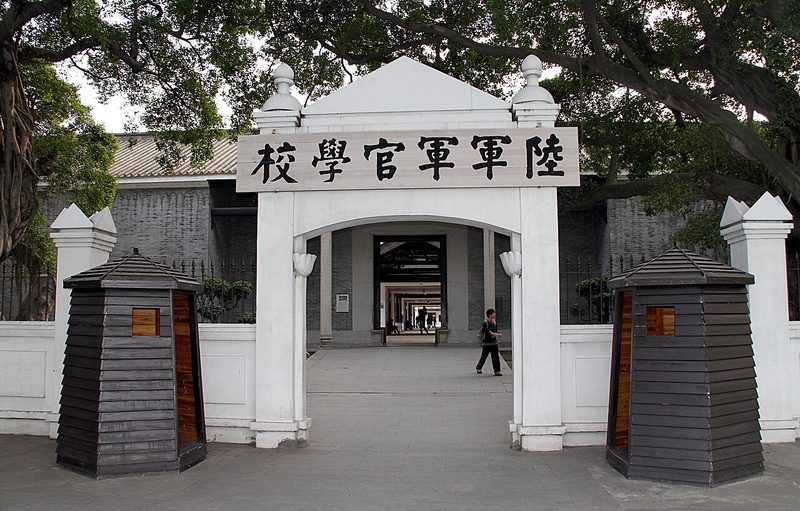
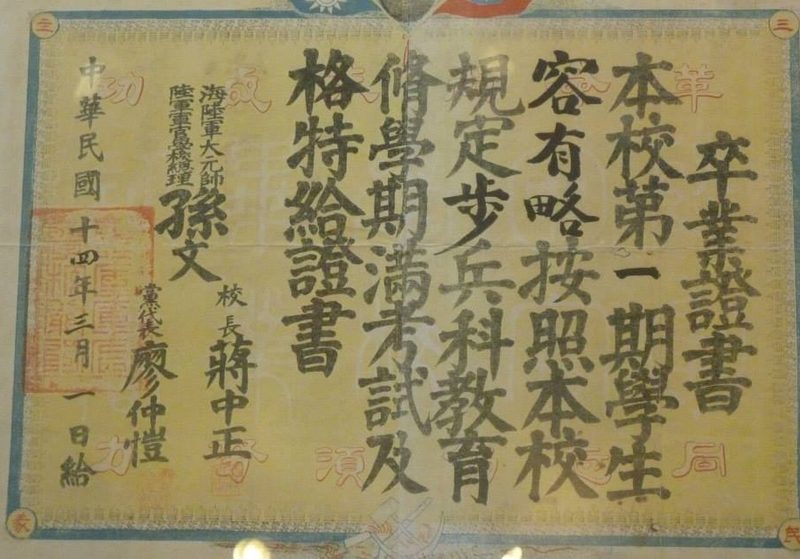
Sun Yat-sen had led the revolution for many years but, lacking his own revolutionary army, often relied on warlords and repeatedly failed. To build a true revolutionary army, in May 1924, with help from the Soviet Union and the Communist Party, Sun founded the Kuomintang Army Officers' Academy on Changzhou Island at Whampoa (Huangpu), Guangzhou, also called the “Whampoa Military Academy”. Sun served as its director-general, Chiang Kai-shek as president and Liao Zhongkai as Party representative; the Soviet Union sent military advisers to help with training and supplied arms and funds. Many Communists worked at the academy: Zhou Enlai became head of the political department in autumn 1924, and Yun Daiying, Xiao Chunu, Nie Rongzhen and Ye Jianying also served there. Its aim was “to create a revolutionary army to save China from destruction”, and the couplet beside its gate read: “Those seeking rank and wealth go elsewhere; those who fear death need not enter here.” It stressed military and political education equally. Many students were Communists and Communist Youth League members, such as Xu Xiangqian, Chen Geng, Zuo Quan and Lin Biao. The cadets formed the backbone of the National Revolutionary Army, helping put down the Guangzhou Merchants' Corps rebellion in 1924 and fighting two Eastern Expeditions against Chen Jiongming in 1925, winning repeated victories and unifying the Guangdong revolutionary base. In July 1925 the Guangzhou National Government was founded and its forces were then reorganized as the National Revolutionary Army. The academy trained many military and political figures for both parties and had far-reaching influence in modern Chinese history. Its old site in Guangzhou is now a memorial museum.
References
Text and images from Wikipedia are used under CC BY-SA and their respective licenses