QingAD 1644–1912
The Tongmenghui and the Three Principles of the People
August 1905
In 1905 Sun Yat-sen merged the Revive China Society and other groups in Tokyo into the Tongmenghui, China’s first national revolutionary party, built on his Three Principles of the People.
View on the timeline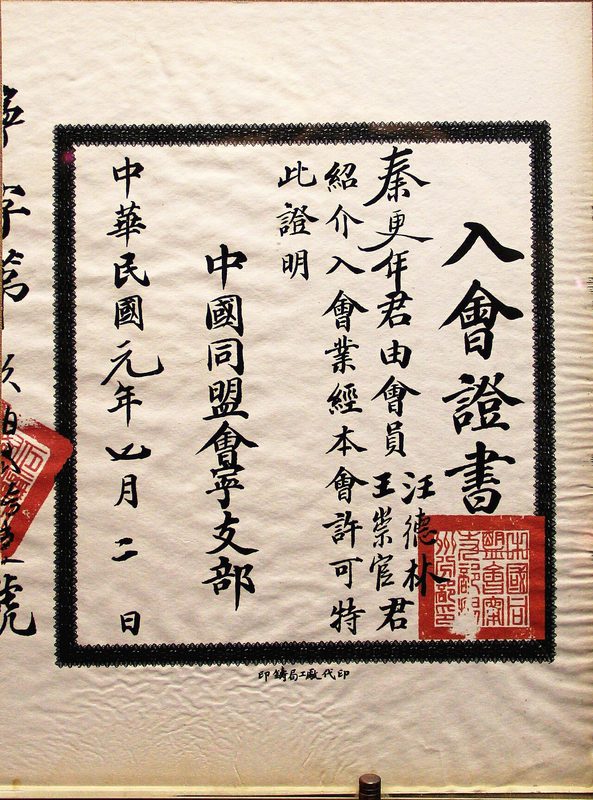
In the early 20th century revolutionary groups sprang up in many places, but they were scattered and fought separately, and the revolution urgently needed a unified organization. On 20 August 1905 Sun Yat-sen united the Revive China Society, China Revival Society, Restoration Society and others and founded the Tongmenghui (Chinese Revolutionary Alliance) in Tokyo, Japan. Sun was elected premier, Huang Xing became head of the executive department, and branches were set up at home and abroad. Its political program was to “expel the Tartars, restore China, establish a republic and equalize land rights,” and it founded the Min Bao. In November Sun’s foreword to the Min Bao summarized the program as three principles, nationalism, democracy and people’s livelihood, the “Three Principles of the People.” Nationalism meant “expelling the Tartars and restoring China,” overthrowing Qing rule by revolution; democracy meant “establishing a republic,” overthrowing feudal monarchy and founding a bourgeois democratic republic; people’s livelihood meant “equalizing land rights,” fixing land prices. The Three Principles were a fairly complete bourgeois democratic program and became the guiding ideology of the 1911 Revolution, though they did not clearly oppose imperialism or propose a thorough anti-feudal land program. After its founding the Tongmenghui used the Min Bao to wage a great debate with royalists led by Kang Youwei and Liang Qichao over whether to overthrow the Qing by revolution, and launched many armed uprisings. It was China’s first national bourgeois revolutionary party, and its founding marked a new stage of the bourgeois democratic revolution.
References
Text and images from Wikipedia are used under CC BY-SA and their respective licenses