QingAD 1644–1912
Abolition of the Imperial Examinations
1901–1905
The late-Qing “New Policies” reformed education; in 1905 the Qing announced the end of the examinations from the next year, abolishing the 1,300-year-old system as new-style schools grew rapidly.
View on the timeline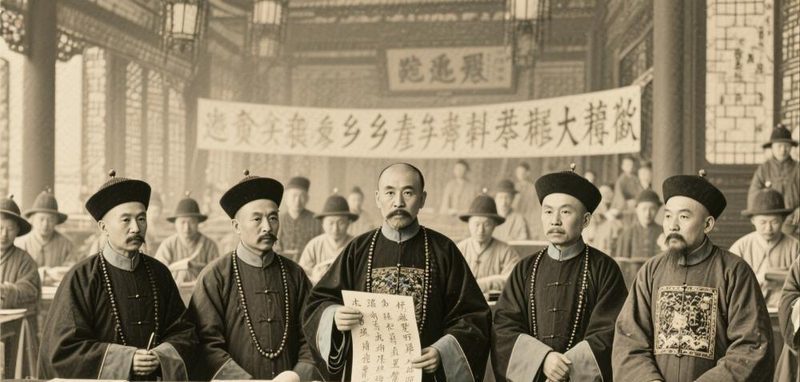
The imperial examination system began in the Sui dynasty, but by the Ming and Qing the eight-legged essay examinations seriously confined thinking. In the Self-Strengthening period reformers founded new schools such as the Tongwen Guan and Fuzhou Naval Academy. After the Sino-Japanese War the Qing founded the Beiyang Western Learning Hall (later Peiyang University) in Tianjin and Nanyang Public School in Shanghai. During the Hundred Days’ Reform it announced the abolition of the eight-legged essay and founded the Imperial University. In 1901, to preserve its rule, the Qing announced the “New Policies”: in education it abolished the eight-legged essay for policy essays, ordered new schools set up everywhere and encouraged study abroad. In 1902 and 1904 it issued the Imperially Approved School Regulations (Renyin system) and the Regulations Approved by Memorial (Guimao system), the latter being China’s first modern school system formally applied nationwide. Because the examinations remained, scholars still pursued them and new schools were hampered. In 1905 Yuan Shikai, Zhang Zhidong and others jointly petitioned to end them at once. In September the Qing announced that examinations would end from 1906, and the system that had lasted 1,300 years was abolished. At the end of that year it set up the Ministry of Education to oversee education nationwide. New schools then grew rapidly: by 1909 there were over 50,000 with over 1.6 million students, and a wave of study abroad appeared. The abolition was a major change in Chinese educational history, shook the feudal education system and promoted modern education and the rise of a new intellectual class.
References
Text and images from Wikipedia are used under CC BY-SA and their respective licenses