QingAD 1644–1912
The Boxer Protocol
September 1901
In 1901 the Qing was forced to sign the Boxer Protocol with eleven countries, paying 450 million taels of silver and fixing a legation quarter, and China became fully semi-colonial and semi-feudal.
View on the timeline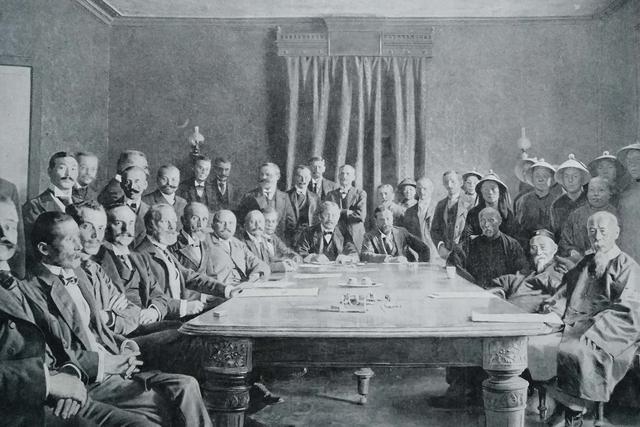
After the Eight-Power force took Beijing, the Qing sent Li Hongzhang and Prince Qing Yikuang as plenipotentiaries to negotiate. On 7 September 1901 the Qing was forced to sign the humiliating Boxer Protocol with eleven countries: Britain, the US, Russia, Japan, France, Germany, Italy, Austria, Belgium, the Netherlands and Spain. Its main terms were: the Qing would pay an indemnity of 450 million taels of silver over 39 years, about 980 million with interest, secured on customs and salt taxes, known as the “Boxer Indemnity”; Beijing’s Dongjiaominxiang was designated a legation quarter in which Chinese could not live and which the powers could garrison; the Qing guaranteed to forbid anti-foreign activity on pain of death and to dismiss officials who suppressed it poorly; and it would raze the Dagu forts and let the powers station troops at twelve places along the railway from Beijing to Shanhaiguan. It was the largest indemnity and most severe loss of sovereignty of any unequal treaty in modern China. The indemnity amounted to a tael of silver per Chinese person and made the people’s burden heavier; the legation quarter became a “state within a state” in the capital; razing the Dagu forts and allowing foreign troops left Beijing open; and the ban on anti-foreign activity showed that the Qing had become a tool of the powers, a “foreigners’ court.” The Protocol marks China’s complete fall into a semi-colonial, semi-feudal society. Later the US and other countries returned part of the indemnity to China for education and study abroad; Tsinghua School (today’s Tsinghua University) was founded with part of the US refund.
References
Text and images from Wikipedia are used under CC BY-SA and their respective licenses