QingAD 1644–1912
Founding of the Imperial University of Peking
1898
Founded during the 1898 reform, the Imperial University of Peking was modern China’s first national university and its top education authority, and the forerunner of Peking University.
View on the timeline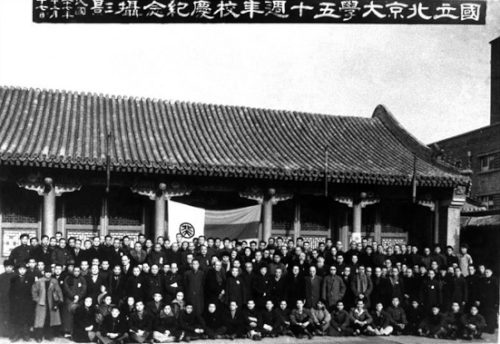
After the Sino-Japanese War the reformers actively urged the founding of new schools to train new talent. In 1896 Li Duanfen, Vice Minister of Justice, formally proposed a university in the capital. During the Hundred Days’ Reform the Guangxu Emperor’s edict stated that “the Imperial University of Peking should lead the provinces and be set up first.” In July he approved the Regulations of the Imperial University drafted by Liang Qichao, appointed Sun Jia’nai, Minister of Personnel, as head, and the American missionary William Martin as chief Western instructor. With the aim of “training talent widely and studying current affairs,” it planned ten departments, including astronomy, geography, moral philosophy, politics, literature, military science, agriculture, engineering, commerce and medicine. It was both the nation’s highest school and its highest educational administration. In December it formally opened in the former mansion of Princess Hejia near Mashen Temple, east of Jingshan in Beijing. After the reform failed almost all new policies were abolished, but the university survived. In 1900 the Eight-Power Allied Forces occupied Beijing, damaged it and forced it to close. In 1902 the Qing appointed Zhang Baixi to restore it. In 1905, with the founding of the Ministry of Education, the university no longer oversaw national education. In 1912 it was renamed Peking University, with Yan Fu as first president. After Cai Yuanpei became president in 1917, he promoted “freedom of thought and inclusiveness,” making it the center of the New Culture Movement. The founding of the Imperial University marks the beginning of modern higher education in China.
References
Text and images from Wikipedia are used under CC BY-SA and their respective licenses