QingAD 1644–1912
The Scramble for Concessions and the Open Door Policy
1897–1899
After the Sino-Japanese War the powers seized leased territories and spheres of influence in a scramble to carve up China; in 1899 the US called for an “Open Door” of equal access.
View on the timeline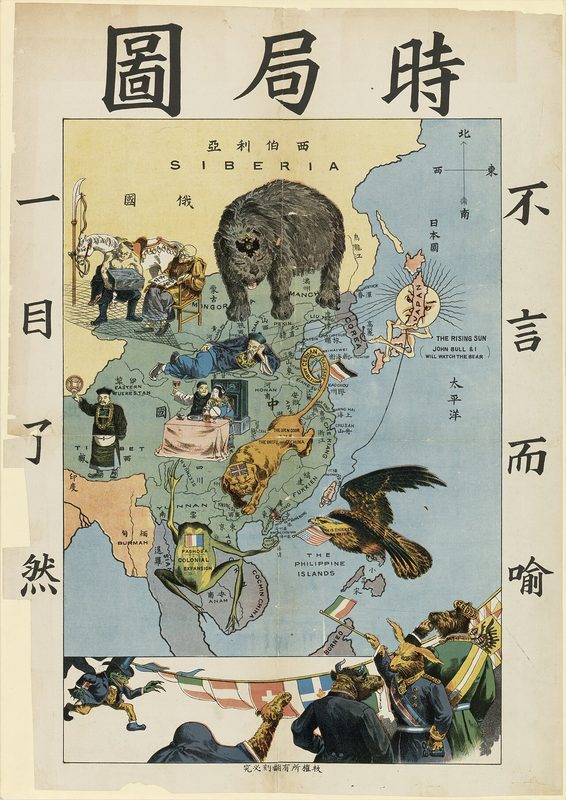
After the Treaty of Shimonoseki, Russia, France and Germany intervened to return Liaodong, and Japan extorted a 30-million-tael “redemption fee” from China. Seizing this chance, the powers launched a scramble in China for rights and interests, leased territories and “spheres of influence.” In 1897 Germany, using the killing of two missionaries at Juye, Shandong, as a pretext, seized Jiaozhou Bay by force, and the next year forced the Qing to lease it and made Shandong its sphere of influence. Russia then seized Lüshun and Dalian, made the area north of the Great Wall its sphere, and gained the right to build the Chinese Eastern Railway and its branches. Britain leased Weihaiwei and northern Kowloon (later the “New Territories”) and made the Yangtze valley its sphere. France leased Guangzhouwan and made Yunnan, Guangdong and Guangxi its sphere, and Japan claimed Fujian. China faced a grave crisis of partition, and someone drew the Map of the Current Situation. The US, busy with the Spanish-American War, could not join the partition. In 1899 US Secretary of State John Hay proposed the “Open Door” policy to Britain, Germany, Russia, Japan, Italy and France, recognizing the powers’ spheres of influence and existing interests while requiring that each open its sphere to the US on equal terms of trade, that is, “equal sharing of benefits.” The powers accepted it, but in essence it was a US policy of widening its own aggressive interests in China. The scramble provoked strong resistance among the Chinese people and spurred the reformers to speed up their drive for strength through reform.
References
Text and images from Wikipedia are used under CC BY-SA and their respective licenses