QingAD 1644–1912
Establishing the Zongli Yamen
1861
In 1861 the Qing set up the Zongli Yamen under Prince Gong Yixin to handle foreign affairs, trade and customs, the first dedicated foreign affairs body of modern China.
View on the timeline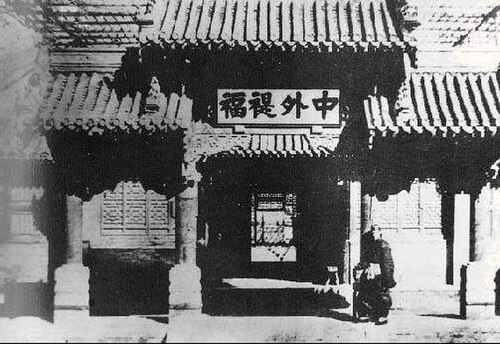
Before the Second Opium War the Qing had no body dedicated to foreign affairs, which were handled by the Board of Rites, the Court of Colonial Affairs, the Governor-General of Liangguang and others. After the war foreign ministers were allowed to reside in Beijing, and the traditional system could no longer cope. In January 1861 Prince Gong Yixin, with Grand Secretary Guiliang and Vice Minister of Revenue Wenxiang, jointly petitioned to set up a special body. With the Xianfeng Emperor’s approval, the Qing established in Beijing the Office for the General Management of the Affairs of All Foreign Countries, called the “Zongli Yamen” or “Zongshu,” headed by Yixin, Guiliang and Wenxiang. It first handled foreign negotiations, but its powers grew to cover trade, customs, sending envoys abroad, new-style schools, railways, mines and arms purchases, making it a powerful central organ and the leading body of the Self-Strengthening Movement. It had British, French, Russian, American and coastal defense sections, and ran the Tongwen Guan language school to train interpreters. The Qing also set up Superintendents of Trade at Tianjin and Shanghai, later held concurrently by the Governors-General of Zhili and of Liangjiang as the Northern and Southern Superintendents of Trade. Its founding marked the start of a shift in Qing diplomacy from the traditional tribute system to a modern diplomatic system and the beginning of the modernization of Chinese diplomacy, though it often yielded to the powers. In 1901, under the Boxer Protocol, it became the Ministry of Foreign Affairs, ranked first among the ministries.
References
Text and images from Wikipedia are used under CC BY-SA and their respective licenses