QingAD 1644–1912
Hong Rengan and A New Treatise on Aids to Administration
1859
In 1859 the Shield King Hong Rengan wrote A New Treatise on Aids to Administration, urging China to learn from the West and build modern industry, its first plan for capitalist development.
View on the timeline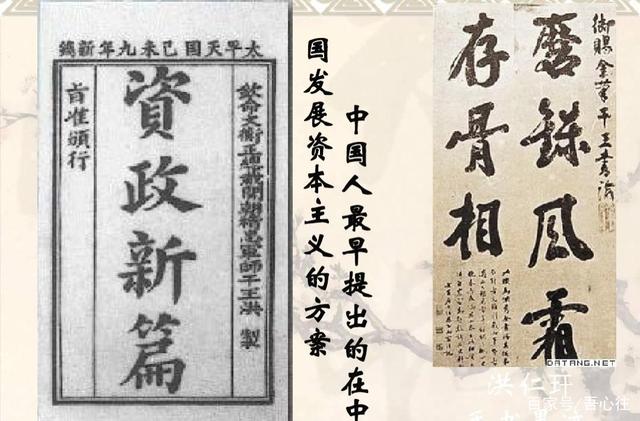
After the Tianjing Incident the Taiping was in difficulty. To turn things around, Hong Xiuquan promoted young commanders such as Chen Yucheng and Li Xiucheng, and relied on his kinsman Hong Rengan, who came to Tianjing from Hong Kong. Hong Rengan (1822–1864), from Huaxian, Guangdong, joined the God Worshippers’ Society early; after the Jintian Uprising he drifted to Hong Kong, where he had close ties with Western missionaries and learned much about Western politics, economy and society. He reached Tianjing in 1859, was made Shield King and put in charge of government. That year he wrote A New Treatise on Aids to Administration (Zizheng Xinpian), proposing reforms modeled on the West. Politically, he favored stronger centralization, “forbidding the evil of factions,” setting up newspaper offices so that “high and low communicate,” and “governing the country by law.” Economically, he urged developing modern mining, industry and transport, founding banks, building railways and steamships, opening mines, encouraging private investment and invention, and protecting patents. Socially, he urged founding schools, hospitals and welfare, and abolishing foot-binding, infanticide and opium smoking. In foreign affairs he favored equal relations and free trade, but no foreign interference in China’s internal affairs. Hong Xiuquan approved and ordered it issued. It was modern China’s first fairly systematic plan to develop capitalism, but because the Taiping was at war and lacked the social basis for such a plan, it was never carried out. After Tianjing fell in 1864 Hong Rengan was captured and died bravely in Nanchang, Jiangxi.
References
Text and images from Wikipedia are used under CC BY-SA and their respective licenses