QingAD 1644–1912
Tsarist Russia Seizes China’s Northern Territory
1858–1881
From 1858 to 1881, tsarist Russia seized over 1.5 million square kilometers of Chinese territory in the Northeast and Northwest through unequal treaties such as the Treaties of Aigun and Beijing.
View on the timeline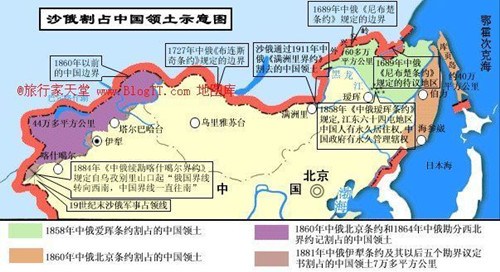
In the mid-19th century tsarist Russia took advantage of the Qing’s domestic and foreign troubles to seize Chinese land. During the Second Opium War, in 1858, Muravyov, Governor-General of Eastern Siberia, threatened force and compelled Heilongjiang General Yishan to sign the Treaty of Aigun, seizing over 600,000 square kilometers north of the Heilong River and south of the Outer Xing’an Range, and placing about 400,000 square kilometers east of the Ussuri River under “joint administration.” In 1860 Russia, claiming credit for “mediation,” obtained through the Sino-Russian Treaty of Beijing the territory east of the Ussuri, including Sakhalin, about 400,000 square kilometers; China thereby lost its Sea of Japan outlet in the Northeast, and Russia founded Vladivostok there. The treaty also set the course of the western Sino-Russian border, laying the groundwork for further seizures in the Northwest. In 1864 Russia obtained, through the Protocol on the Northwestern Boundary, over 440,000 square kilometers east and south of Lake Balkhash. In 1871 it used unrest in Xinjiang to occupy the Ili region. After Xinjiang was recovered, the Qing sent Chonghou to Russia to negotiate; he signed the Treaty of Livadia without authorization, betraying China’s interests, and it met strong opposition at court and in the country. In 1881 Zeng Jize, after hard negotiations, concluded the revised Treaty of Ili, regaining the nine cities of Ili and the Tekes River valley, though areas west of the Khorgos River and elsewhere were still ceded. From the 1850s to the 1880s Russia took over 1.5 million square kilometers of Chinese territory.
References
Text and images from Wikipedia are used under CC BY-SA and their respective licenses