JinAD 266–420
Gu Kaizhi and Wei–Jin Painting
Eastern Jin
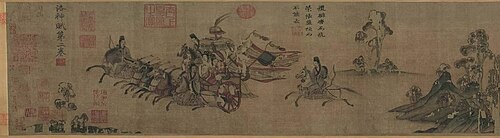
The Eastern Jin painter Gu Kaizhi excelled at figure painting and held that “form should convey spirit”; copies of Admonitions of the Court Instructress and Nymph of the Luo River survive.
View on the timeline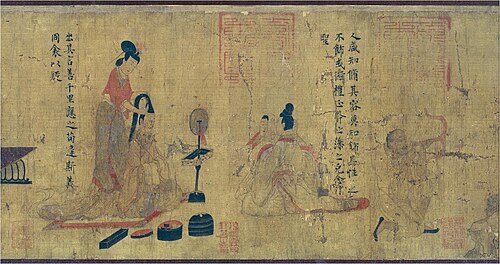
In the Wei, Jin and Northern and Southern Dynasties, painting developed greatly. With Buddhism flourishing, religious painting held an important place, figure painting matured, and landscape painting began to take shape. Gu Kaizhi (c. 345–406), courtesy name Changkang and childhood name Hutou, from Wuxi in Jinling (present-day Wuxi, Jiangsu), was the most famous painter of the Eastern Jin. He excelled at figures, Buddhist images and landscapes, especially figure painting. His lines were fine and continuous like “silk spun by a spring silkworm,” and his figures were lifelike and individual. In theory he proposed ideas such as “form conveys spirit” and “transferring thought to grasp the subtle,” stressing that a painting should express a person's inner spirit and not merely the outward form. It is said he left a portrait's eyes unpainted for years, explaining, “The conveying of spirit lies precisely in the eyes.” No original by Gu survives; the Admonitions of the Court Instructress, Nymph of the Luo River and Wise and Benevolent Women that come down are copies by later hands. Admonitions of the Court Instructress, based on Zhang Hua of the Western Jin's essay of that name, promotes the moral norms women should follow; its Tang copy is in the British Museum in London. Nymph of the Luo River, based on Cao Zhi's famous Rhapsody on the Nymph of the Luo, shows Cao Zhi's meeting and parting with the goddess of the Luo River. His On Painting is among China's earliest painting treatises. In this period, with more landscape poetry and scholars finding solace in nature, landscape painting began to form an independent genre, and the “Six Principles of Painting” put forward by Xie He of the Southern Dynasties became an important theory of Chinese painting.
References
Text and images from Wikipedia are used under CC BY-SA and their respective licenses