JinAD 266–420
Battle of Fei River
AD 383
In AD 383 Fu Jian of the Former Qin marched south with a huge army, but the Eastern Jin defeated it at the Fei River with some 80,000 elite troops, “mistaking wind and cranes for pursuers.”
View on the timeline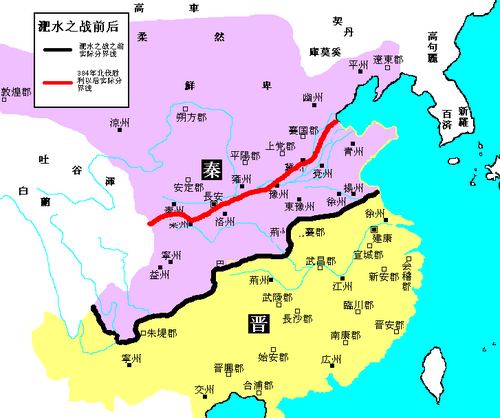
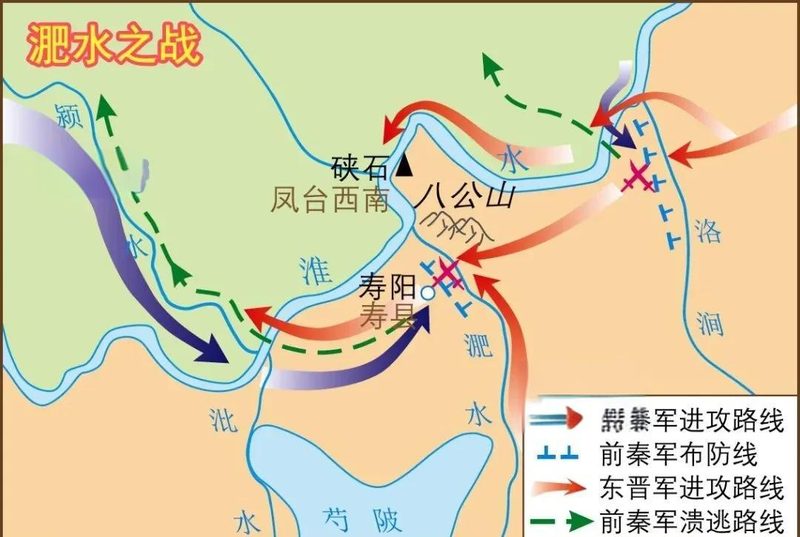
In the Sixteen Kingdoms period, the Di-led Former Qin under Fu Jian employed the Han scholar Wang Meng as chancellor, reformed administration and developed production, grew stronger, unified the north, and stood against the Eastern Jin. In AD 383 Fu Jian, over his ministers' objections, conscripted people of all nationalities, gathering more than 600,000 infantry and 270,000 cavalry, claimed as a million, and marched south in force, hoping to destroy the Eastern Jin and unify the country at one stroke. Fu Jian boasted that “if my host threw their whips into the river, they could stop its flow.” The Eastern Jin chancellor Xie An stayed calm and sent Xie Shi and Xie Xuan with some 80,000 elite “Beifu troops,” mostly northern refugees, to meet them. The Jin first defeated the Qin vanguard at Luojian, then faced the Qin on the two banks of the Fei River (southeast of present-day Shou county, Anhui). Xie Xuan asked the Qin to pull back a little so the Jin could cross; Fu Jian, planning to strike them half across, ordered a retreat, but once the Qin fell back their lines fell into disorder, and the captured Jin officer Zhu Xu shouted behind the lines, “The Qin are beaten!” and the Qin army broke. The Jin crossed and attacked fiercely; fleeing Qin soldiers took the sound of wind and the cry of cranes for Jin pursuers and the grass and trees of Mount Bagong for Jin troops, giving the idioms “mistaking wind and cranes for pursuers” and “seeing every bush as a soldier.” It is a famous case of a smaller force beating a larger one. Afterward the leaders of the peoples under Former Qin became independent one after another, the Former Qin collapsed quickly, and the north was divided again. The Eastern Jin kept its rule in Jiangnan and the north–south standoff continued.
References
Text and images from Wikipedia are used under CC BY-SA and their respective licenses