Northern and Southern DynastiesAD 420–589
End of the Eastern Jin and the Southern Dynasties
AD 420–589 · Jin → Northern and Southern Dynasties
Liu Yu replaced the Jin with the Song in AD 420; the south then saw four dynasties, Song, Qi, Liang and Chen, all based at Jiankang, the “Southern Dynasties,” until the Sui destroyed the Chen in 589.
View on the timeline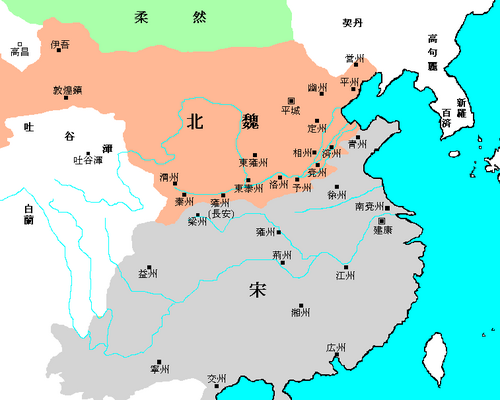
Liu Yu, a Beifu general, rose by suppressing the uprisings of Sun En and Lu Xun and other rebellions, then led two northern expeditions that destroyed Southern Yan and Later Qin and briefly recovered Luoyang and Chang'an. In AD 420 Liu Yu deposed Emperor Gong of Jin and took the throne under the state name Song, known as Liu Song, and the Eastern Jin fell. From 420 to 589, regimes in southern China changed often, with four dynasties in turn, Song, Qi, Liang and Chen, all with their capitals at Jiankang (present-day Nanjing, Jiangsu), together the “Southern Dynasties,” facing the Northern Dynasties in the “Northern and Southern Dynasties.” The Song was the largest Southern dynasty; during the more than thirty years of Emperor Wu, Liu Yu, and Emperor Wen, Liu Yilong, light taxes and corvée and administrative reform brought relative peace and prosperity to Jiangnan, called the “Yuanjia Era Rule.” In 479 Xiao Daocheng replaced the Song with the Qi, and in 502 Xiao Yan replaced the Qi with the Liang, as Emperor Wu of Liang. In nearly fifty years on the throne, Emperor Wu of Liang devoutly believed in Buddhism and built many temples, four times giving himself to Tongtai Temple, for which the court paid huge sums to redeem him. In 548 Hou Jing, a defecting general of Eastern Wei, rebelled and took Jiankang, Emperor Wu was besieged and starved to death, and Jiangnan's richest regions were plundered, known as the “Rebellion of Hou Jing.” In 557 Chen Baxian founded the Chen dynasty, but its territory was much smaller and the south was clearly at a disadvantage. In 589 Sui troops crossed the river and took Jiankang, the last Chen emperor was captured, the Chen fell, and China was reunified. The economy and culture of Jiangnan greatly developed during the Southern Dynasties.
References
Text and images from Wikipedia are used under CC BY-SA and their respective licenses