Eastern HanAD 25–220
Ban Chao Manages the Western Regions
From AD 73
Under Emperor Ming of the Eastern Han, Ban Chao went to the Western Regions, “threw away the brush for the sword,” and over thirty years restored Han authority there.
View on the timeline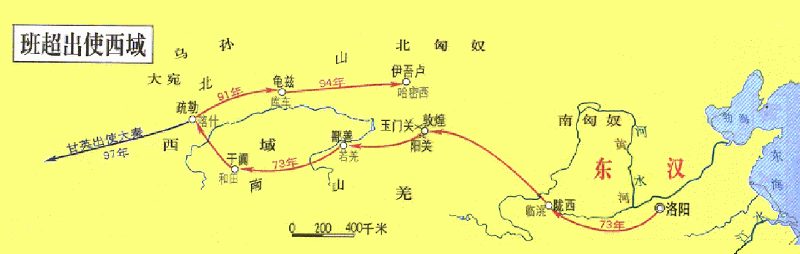
At the end of the Western Han the Xiongnu regained control of the Western Regions and contact with the Central Plains was cut. In the early Eastern Han the states there, oppressed by the Xiongnu, asked to submit to the Han. Ban Chao was the younger brother of Ban Gu, author of the Book of Han; he earned his living as a copyist in youth and then resolved to emulate Zhang Qian and win merit abroad, “throwing away the brush to join the army.” In AD 73 Emperor Ming sent Dou Gu against the Xiongnu; Ban Chao fought with the army and won merit, then was ordered to lead 36 men as envoys to the Western Regions. In the state of Shanshan, Xiongnu envoys had also arrived and the king was cool toward the Han. Ban Chao said, “Without entering the tiger's den, how can you get the tiger's cub?” and led his men in a night attack on the Xiongnu camp, wiping out the mission, after which the king of Shanshan submitted to the Han. Ban Chao then put down pro-Xiongnu forces in Khotan, Shule and elsewhere, united the states of the Western Regions, and resisted attacks by the Xiongnu and the Kushan Empire. In AD 91 he was appointed Protector General of the Western Regions, stationed at Qiuci, and the next year the Eastern Han restored its authority there, with over fifty states submitting. In AD 97 Ban Chao sent his subordinate Gan Ying to Daqin (the Roman Empire); Gan Ying reached the sea shore at Tiaozhi in western Parthia but turned back because the Parthians exaggerated the dangers of the voyage. It was the farthest west any Chinese envoy had traveled then. After over thirty years in the region, the aged Ban Chao asked to return, writing, “I dare not hope to reach Jiuquan, only to enter Yumen Pass alive.” He came back to Luoyang in AD 102 and died soon after at 71.
References
Text and images from Wikipedia are used under CC BY-SA and their respective licenses