Qin221–207 BC
Battle of Julu and Fall of Qin
207 BC
In 207 BC Xiang Yu destroyed the main Qin army at Julu by burning his boats and smashing his cauldrons; Liu Bang entered Guanzhong, Ziying surrendered, and the Qin dynasty fell.
View on the timeline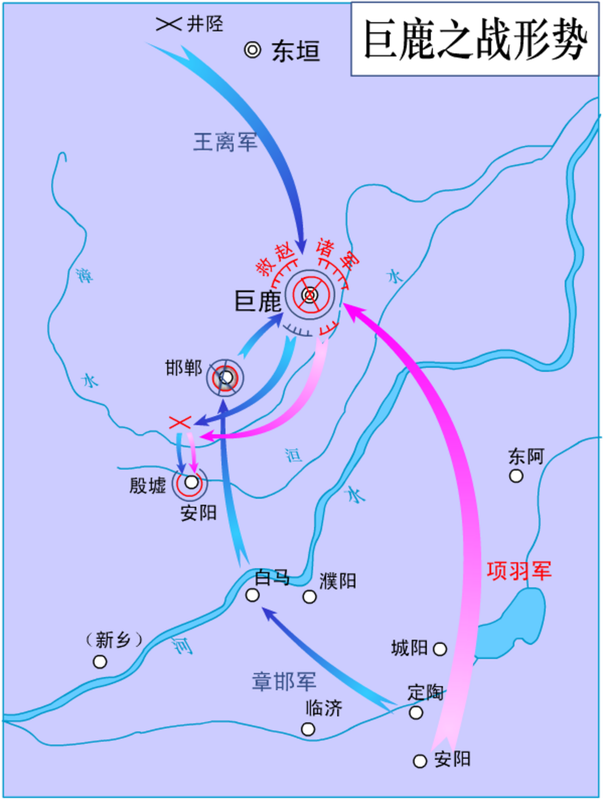
After the Chen Sheng and Wu Guang uprising failed, anti-Qin struggles continued everywhere, and the forces led by Xiang Yu and Liu Bang grew into the main anti-Qin forces. In 208 BC the Qin general Zhang Han, having defeated Xiang Liang, crossed the Yellow River northward to attack Zhao and sent Wang Li to besiege King Xie of Zhao at Julu (southwest of present-day Pingxiang, Hebei), with a Qin force said to number 400,000. King Huai of Chu sent Song Yi as commander and Xiang Yu as deputy to relieve Zhao, and sent Liu Bang west to Guanzhong, agreeing that “whoever enters Guanzhong first shall be king there.” Song Yi lingered at Anyang for over forty days without advancing; Xiang Yu killed him and took command. In 207 BC, after crossing the Zhang River, Xiang Yu ordered the cooking pots smashed, the ferry boats sunk and the tents burned, each man carrying only three days' food, to show a fight to the death, the origin of the idiom “smash the cauldrons and sink the boats.” The Chu troops, each fighting like ten, won nine battles in nine, broke the Qin army and captured Wang Li, and the lords' troops who had watched from the walls did not dare look up at Xiang Yu. Soon Zhang Han surrendered with 200,000 Qin troops. The Battle of Julu, a victory of the few over the many, destroyed Qin's main force and laid the basis for its overthrow. Meanwhile Liu Bang avoided the main Qin army, entered Wu Pass in the west and pressed on Xianyang. Inside Qin, Zhao Gao killed the Second Emperor and made Ziying king of Qin, and Ziying then killed Zhao Gao by a ruse. In 207 BC Ziying surrendered to Liu Bang outside Xianyang, and Qin fell.
References
Text and images from Wikipedia are used under CC BY-SA and their respective licenses