MingAD 1368–1644
Xu Guangqi and Matteo Ricci Translate Elements
Mid to Late Ming
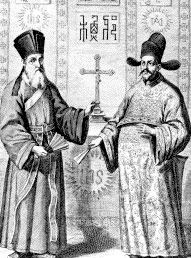
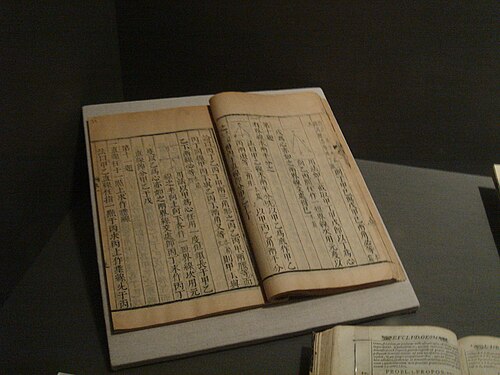
Xu Guangqi and the Italian missionary Matteo Ricci translated the first six books of Euclid's Elements, fixing Chinese terms such as "geometry", "point" and "line".
View on the timeline
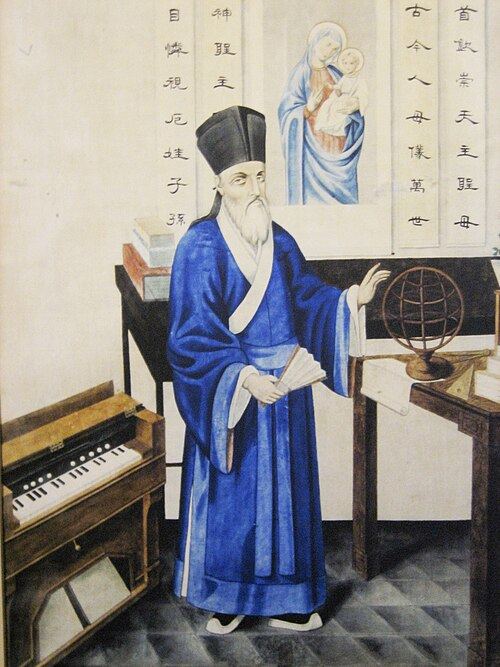
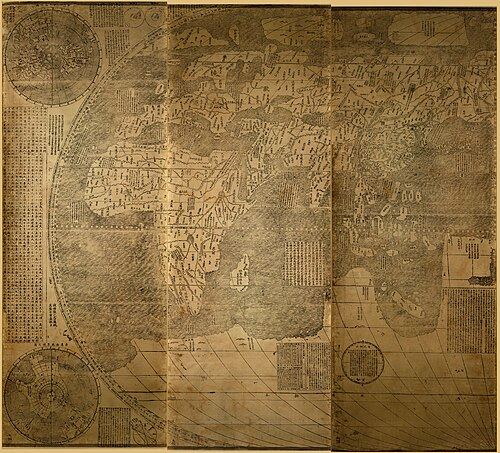
In the mid and late Ming, European Jesuit missionaries came to China to preach and brought Western knowledge of astronomy, mathematics, geography and other sciences. The Italian missionary Matteo Ricci (1552–1610) was a leading figure; he reached Macao in 1582 and the next year went to Zhaoqing, Guangdong, to preach. He learned Chinese, wore Confucian dress, studied the Confucian classics and befriended scholar-officials, and was respected as a "Confucian scholar of the Far West"; in 1601 he was permitted to go to Beijing and presented the Wanli Emperor with items such as a striking clock. His world map, Kunyu Wanguo Quantu, broadened Chinese horizons. Xu Guangqi (1562–1633), courtesy name Zixian, art name Xuanhu, was from Shanghai; he converted to Catholicism in 1603, passed the jinshi examination the next year, eagerly studied Western science and rose to Minister of Rites and Grand Secretary of the Dongge Hall. From 1606 Xu worked with Ricci to translate the Greek mathematician Euclid's Elements, completing and publishing the first six books in 1607. Elements starts from definitions and axioms and proves a series of theorems by rigorous logic; Xu praised it as "seemingly most obscure, yet in truth most clear" and held that it "can make students of theory shed their rashness and refine their minds". "Jihe" (geometry) and terms such as "point", "line", "triangle" and "quadrilateral" were fixed in this translation and are still used today. Xu also translated with Ricci works such as Celiang Fayi (On Surveying). Their cooperation was an important result of Sino-Western cultural exchange in the late Ming and deeply influenced the development of Chinese mathematics.

References
Text and images from Wikipedia are used under CC BY-SA and their respective licenses