TangAD 618–907
Kaiyuan Golden Age
713–741
In his early reign Emperor Xuanzong used able chancellors like Yao Chong and Song Jing, reformed officialdom and developed the economy. Tang reached its height, the “Kaiyuan Golden Age”.
View on the timeline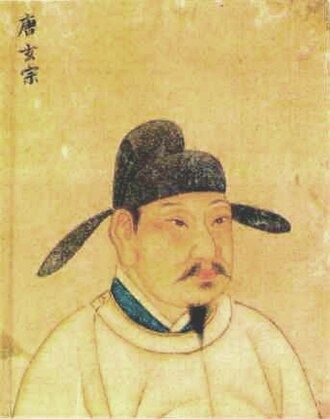
Emperor Xuanzong of Tang, Li Longji (685–762), was a grandson of Wu Zetian and a son of Emperor Ruizong. In 710 he staged a coup that killed Empress Wei's faction, took the throne in 712, and in 713 adopted the era name “Kaiyuan”. In his early reign he governed diligently and used capable men, appointing Yao Chong, Song Jing, Zhang Yue, Zhang Jiuling and others as chancellors, and carried out a series of reforms. He tidied official administration and cut redundant posts, paid attention to selecting local officials, personally tested county magistrates and dismissed at once those who failed. He developed the economy by registering households that had fled, raising state tax revenue, building irrigation works and promoting military farming colonies. He valued culture and set up the Academy of Worthies to collate and compile books. After over twenty years of rule, Tang had vast territory and Chang'an became a cosmopolitan city thronged with envoys, merchants and students. Government was stable, the economy flourished, the treasury was full, households grew to over eight million, society was calm and grain prices were low. Tang power reached its peak, known as the “Kaiyuan Golden Age”. The poet Du Fu described it in “Recalling the Past”: “I recall the full glory of Kaiyuan, when even a small town held ten thousand households. Rice was glossy and millet white, and granaries public and private were full.” But in the later Kaiyuan years Xuanzong grew complacent and idle and indulged in pleasure, appointing Li Linfu and then Yang Guozhong as chancellors. Government became increasingly corrupt, the military governors grew powerful, and tensions accumulated, until the An Lushan Rebellion broke out in 755 and Tang went from prosperity into decline.
References
Text and images from Wikipedia are used under CC BY-SA and their respective licenses