Neolithicc. 10,000 years ago–2070 BC
Hemudu Culture
c. 7,000 years ago
The Hemudu site in Yuyao, Zhejiang, c. 7,000 years old, shows rice farming, stilt houses and wooden wells, and is a major representative of Yangtze River civilization.
View on the timeline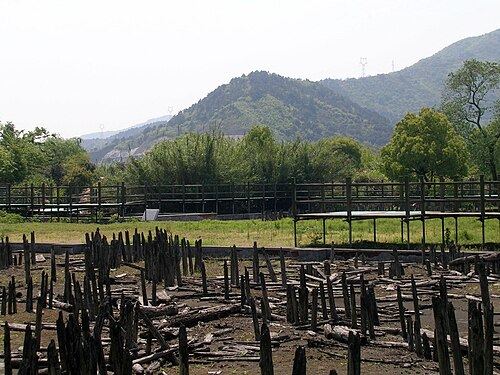
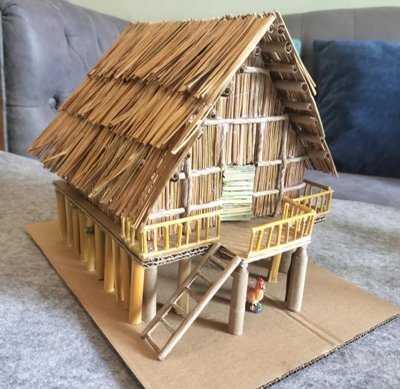
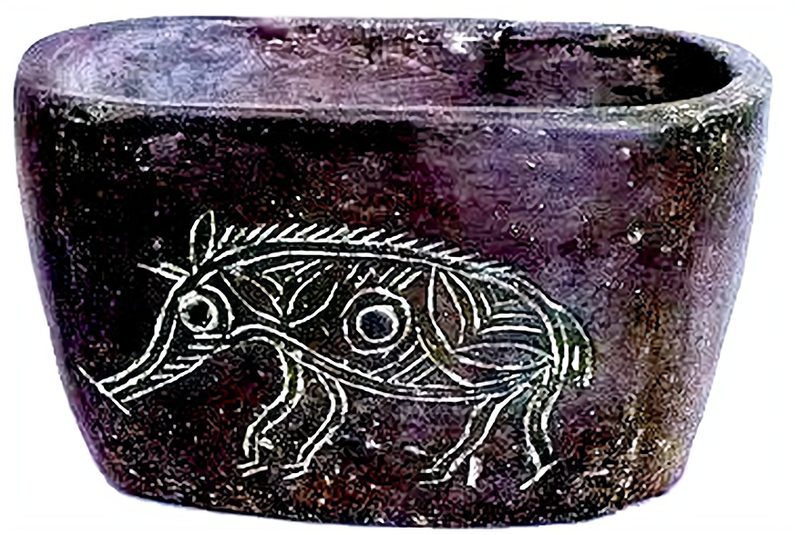
The Hemudu culture was a Neolithic culture found on the plain south of Hangzhou Bay and on the Zhoushan Islands, dated to about 7,000–5,000 years ago. It is named after the Hemudu site in Yuyao, Zhejiang, first discovered in 1973. Seven or eight thousand years ago the lower Yangtze was warm and humid, and the Hemudu people grew mainly rice. The site contains large deposits of rice grain, husks, stalks and leaves, up to about 1 meter thick, and the grains are close in form to modern cultivated rice, showing that the middle and lower Yangtze was one of the origins of rice farming in Asia. A typical farm tool was the bone spade made from water buffalo shoulder blades, and domestic animals included pigs, dogs and water buffalo. Hemudu houses were stilt buildings: wooden piles were driven into the ground, a floor laid on top and the house built above, which kept out damp and animals. Mortise-and-tenon joints were widely used and had a deep influence on later Chinese timber architecture. One of the earliest known wooden-lined wells was also found. The Hemudu people made black pottery, jade objects and bone whistles, and carved ivory and bone into art such as the “two birds facing the sun” piece, one of China's earliest ivory carvings; a vermilion-lacquered wooden bowl shows they knew how to use natural lacquer. The Hemudu culture strongly demonstrates that the Yangtze, like the Yellow River, was an important cradle of Chinese civilization. A site museum at Hemudu has reconstructed stilt buildings. Together with the Majiabang culture, Hemudu forms the rich prehistoric culture of the lower Yangtze, on whose land the later Liangzhu civilization developed.
References
Text and images from Wikipedia are used under CC BY-SA and their respective licenses