Paleolithicc. 2 million–10,000 years ago
Upper Cave Man
c. 30,000 years ago
Upper Cave Man, c. 30,000 years ago, looked much like modern humans, polished and drilled objects, sewed clothes with bone needles, made fire, and wore ornaments.
View on the timeline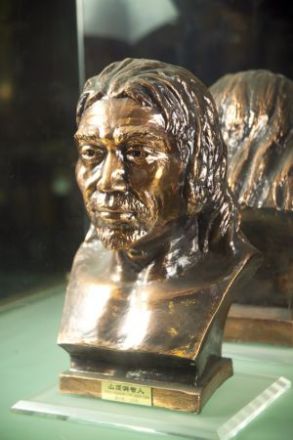
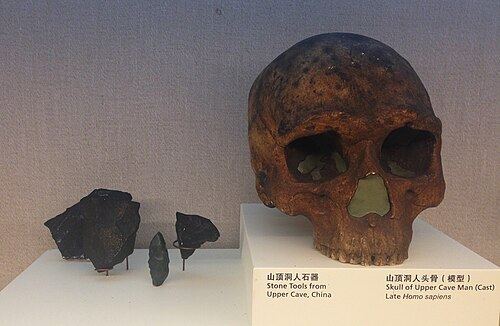
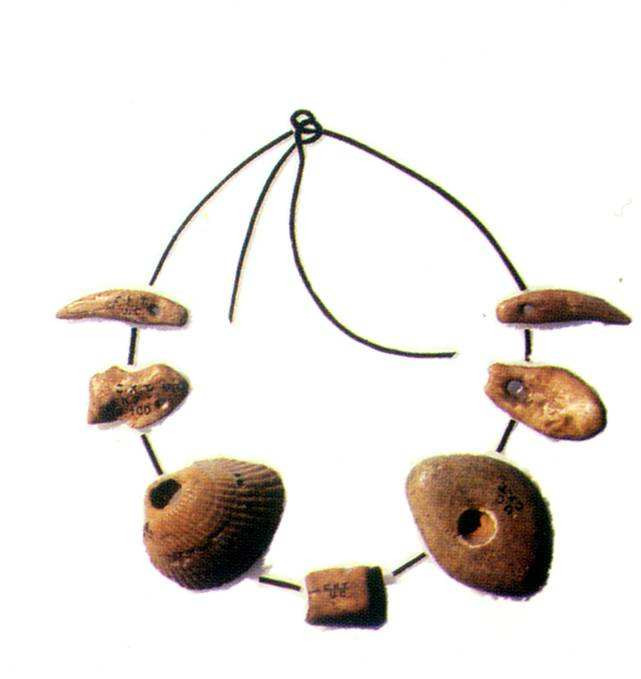
Upper Cave Man was a late Homo sapiens who lived about 30,000 years ago. The fossils were found in a cave near the top of Dragon Bone Hill at Zhoukoudian, Beijing, hence the name. The site was discovered in 1930 and excavated in 1933–1934 under Pei Wenzhong, yielding three complete skulls and skeletal fossils representing at least eight individuals. Their brain size and skull form are close to those of modern humans. Sadly, these fossils disappeared in 1941 together with the Peking Man fossils, and today research relies on carefully made casts. Upper Cave people still used chipped stone tools but had mastered polishing and drilling. A bone needle about 8 cm long with a tiny eye, found at the site, is the earliest sewing tool found in China and shows they sewed clothes from animal skins. They could make fire and lived by gathering, hunting and fishing. The site also yielded ornaments such as perforated animal teeth, stone beads and clam shells, some dyed red with hematite, which reflects a sense of beauty; the shells came from a distant seashore, suggesting exchange with faraway groups. They also buried their dead, sprinkling hematite powder around the remains. They lived collectively, working and sharing together, with no distinction of rich and poor. Upper Cave Man was dated by the carbon-14 method, which is suitable only for organic remains younger than about 50,000 years. The discovery shows that early humans in China had reached a stage close to modern humans.

References
Text and images from Wikipedia are used under CC BY-SA and their respective licenses