SuiAD 581–618
Three Departments and Six Ministries
600
Three departments divided central government in Tang China.
View on the timeline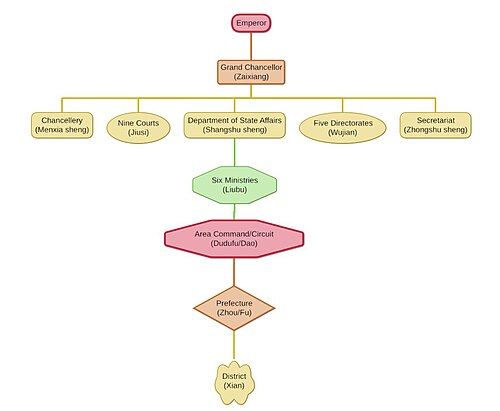
Image: Qiushufang · CC BY-SA 4.0 · Original
The Three Departments and Six Ministries was a framework for central administration that took shape in the Sui and Tang periods and was repeatedly altered thereafter. In its familiar form, the Secretariat drafted imperial orders, the Chancellery reviewed them and could raise objections, and the Department of State Affairs supervised six ministries: Personnel, Revenue, Rites, War, Justice, and Works. This division distinguished drafting, review, and implementation while organizing routine government by function. The Sui institutionalized important elements, and Tang practice developed them alongside the examination system and other offices. The balance of authority was never fixed: emperors used councils, commissions, and delegated posts to change how decisions were made. In the Song, the names and functions of the departments increasingly diverged; under the Yuan the Secretariat became especially powerful. The Ming abolished the Department of State Affairs, placing the ministries more directly under the emperor. The system is therefore not a single unchanged constitution lasting for centuries, but a flexible set of offices that evolved with administrative needs and royal power. Its history is best understood by comparing formal titles with actual responsibilities in each dynasty.
References
Text and images from Wikipedia are used under CC BY-SA and their respective licenses