SuiAD 581–618
Opening of the Grand Canal
From AD 605
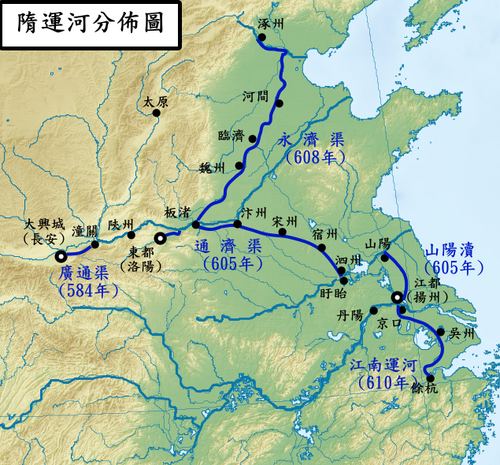
From AD 605 Emperor Yang of Sui had the Grand Canal dug, centered on Luoyang, reaching Zhuojun in the north and Yuhang in the south, over 2,700 km long, a great artery linking north and south.
View on the timeline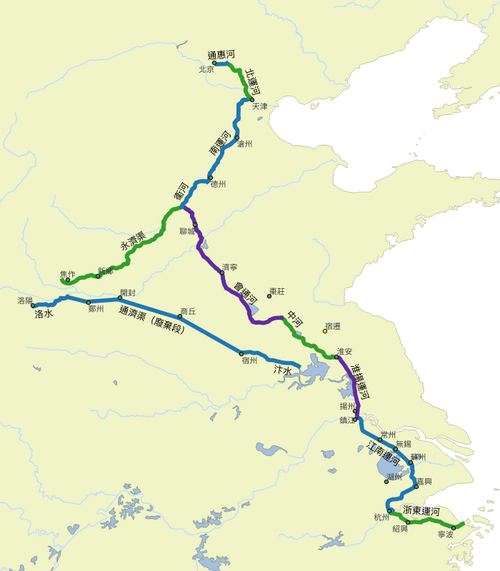
After unification the Sui's political center was in the north while Jiangnan's economy was growing; to improve north–south transport, consolidate rule and ship Jiangnan's grain and goods north, the Sui dug the Grand Canal on the basis of existing natural rivers and ancient canals. After taking the throne, Emperor Yang drew on the state's economic strength and conscripted millions of laborers to dig it in stages from AD 605: in 605 the Tongji Canal was opened, joining the Yellow River and the Huai River, and the Han Canal (Shanyang Canal) was dredged to link the Huai and Yangtze; in 608 the Yongji Canal was dug, drawing the Qin River south to the Yellow River and running north to Zhuojun (around present-day Beijing); in 610 the Jiangnan Canal was dug from Jingkou (present-day Zhenjiang, Jiangsu) to Yuhang (present-day Hangzhou, Zhejiang). Centered on Luoyang, the canal reached Zhuojun in the north and Yuhang in the south, linking the five river systems of the Hai, Yellow, Huai, Yangtze and Qiantang rivers, over 2,700 km long and the longest canal in the ancient world. Emperor Yang overworked the people in digging it, many laborers died of exhaustion, and social tensions rose, one cause of the Sui's fall. But the canal greatly eased north–south travel and exchange and was of great importance for national unity. The Tang poet Pi Rixiu judged: “All say the Sui fell because of this river; yet to this day it carries thousands of li of waves for us.” In the Tang and Song it was the great artery carrying southern grain north. After the Yuan made Dadu its capital, the Huitong and Tonghui canals were dug in straighter courses, forming the Beijing–Hangzhou Grand Canal. In 2014 China's Grand Canal was inscribed on the World Heritage List.
References
Text and images from Wikipedia are used under CC BY-SA and their respective licenses