Three KingdomsAD 220–280
The Nine Chapters on the Mathematical Art
263
The Nine Chapters preserved ancient Chinese mathematics.
View on the timeline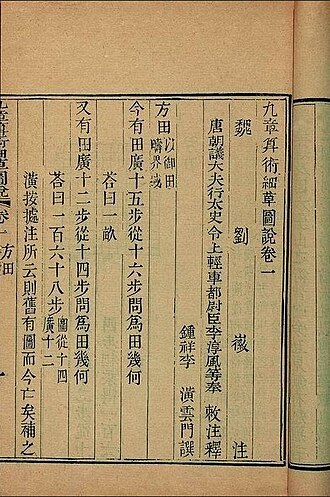
Image: 中國書店海王邨公司 · Public domain · Original
The Nine Chapters on the Mathematical Art is a foundational Chinese mathematical text assembled over time and substantially shaped during the Han period, with its received form established around the first century CE. Its nine sections present practical problems and procedures involving field measurement, grain exchange, proportional distribution, roots, construction volumes, transport and taxation, excess and deficit, linear equations, and right triangles. The methods answered administrative and economic needs such as surveying land, managing stores, allocating goods, and planning works. In the chapter on equations, counting rods arranged in a coefficient array provide a systematic way to solve simultaneous linear problems. Liu Hui’s third-century commentary explains procedures and adds mathematical reasoning, including work on geometry and numerical approximation. Later scholars continued this computational tradition. The book differs in organization from Greek axiomatic geometry, but that contrast should not be reduced to theory versus mere practice: it embodies its own rigorous method-centered approach. The text was compiled by multiple hands, and its history includes commentary and transmission. Manuscripts, later editions, and mathematical historiography are needed to reconstruct the origin and meaning of individual algorithms.
References
Text and images from Wikipedia are used under CC BY-SA and their respective licenses