Western Han202 BC–AD 8
Four Commanderies of Han
108 BCE
Han China established four commanderies in northern Korea.
View on the timeline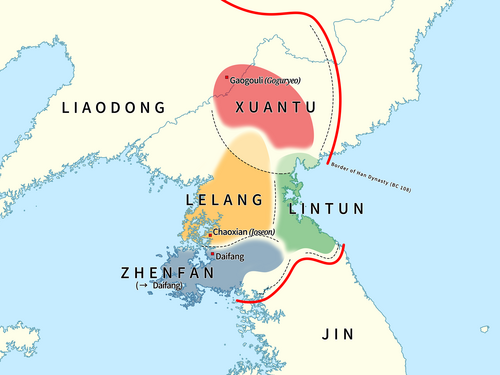
Image: Stillskywkpd · CC BY 4.0 · Original
The Four Commanderies of Han conventionally refers to Lelang, Xuantu, Zhenfan, and Lintun, established after the Han conquest of Wiman Joseon around 108 BCE in the northern Korean Peninsula and neighboring areas. Their territories, headquarters, and administrative arrangements changed over time; some commanderies were moved, merged, or abolished relatively early, while Lelang lasted much longer. The commanderies mark an episode of Han expansion into the northeast, where military occupation, migration, trade, and local administration intersected. Archaeological sites, tombs, seals, coins, and written materials help historians trace these changes, but they do not imply uniform control across every area or period. Local communities and neighboring polities continued to shape political life. Modern national histories often attach contemporary political meaning to the commanderies, so it is important to distinguish ancient administrative names and archaeological findings from modern borders and identities. “Four Commanderies” is a convenient collective label, not proof that all four operated simultaneously with fixed boundaries throughout their history. Their changing organization is best studied chronologically and region by region.
References
Text and images from Wikipedia are used under CC BY-SA and their respective licenses