People's Republic of China1949–present
Beijing–Shanghai High-Speed Railway Opens
30 June 2011
On 30 June 2011 the Beijing–Shanghai High-Speed Railway opened, about 1,318 km long, then the longest and highest-standard high-speed line ever built in a single phase.
View on the timeline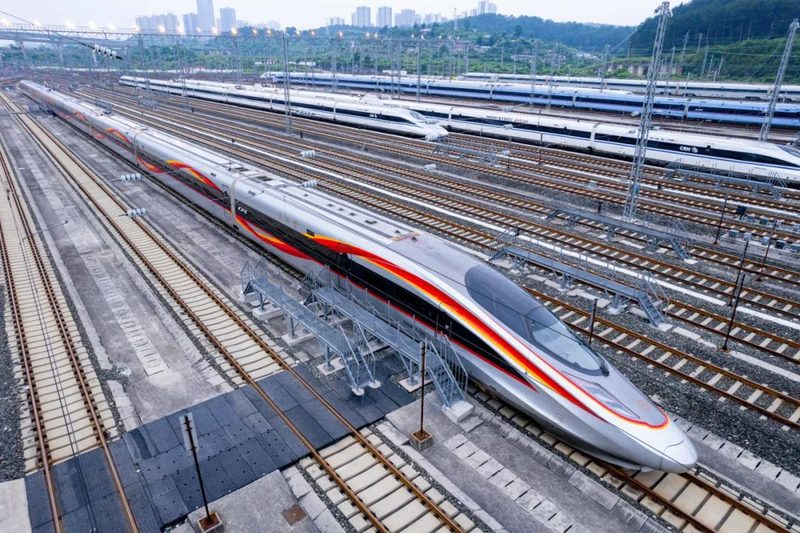
Before the founding of the People’s Republic, China’s transport was very backward, with only a little over 20,000 km of railway. Afterward the state invested heavily in improving transport, with great results, and after reform and opening-up the railways were sped up several times. In August 2008 the Beijing–Tianjin Intercity Railway, China’s first high-speed line designed for 350 km/h, opened. Construction of the Beijing–Shanghai High-Speed Railway began in April 2008 and, after about three years, it opened on 30 June 2011. It runs from Beijing South Station to Shanghai Hongqiao Station, about 1,318 km, through seven provincial-level regions, linking the two most economically developed areas, the Bohai Rim and the Yangtze River Delta. Designed for 350 km/h, it brought the fastest Beijing–Shanghai journey to a little over four hours. Its builders overcame technical problems such as soft-soil foundations and very long bridges; the Danyang–Kunshan Grand Bridge, 164 km long, is among the longest bridges in the world. China’s high-speed rail then grew by leaps and bounds, with the Beijing–Guangzhou, Harbin–Dalian and Shanghai–Kunming lines opening in turn and the “eight vertical and eight horizontal” network taking shape. In 2017 the Fuxing bullet trains, with fully independent intellectual property rights, first entered service on the Beijing–Shanghai line. By the end of 2023 China’s high-speed rail network exceeded 45,000 km in operation, the longest in the world. Chinese high-speed rail has become a brilliant “national calling card” and has gone abroad, taking part in overseas projects such as Indonesia’s Jakarta–Bandung high-speed railway.
References
Text and images from Wikipedia are used under CC BY-SA and their respective licenses