People's Republic of China1949–present
September 13 Incident
13 September 1971
In September 1971 the Lin Biao clique's plot for an armed coup was exposed, and on 13 September Lin Biao and others fled by plane and died in a crash at Öndörkhaan, Mongolia.
View on the timeline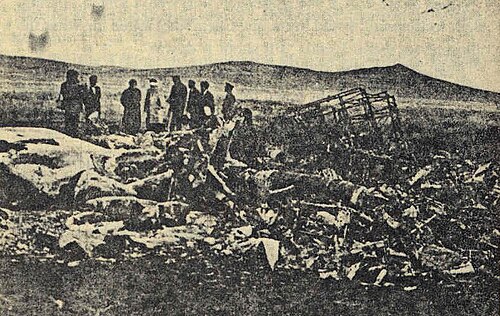
After the Cultural Revolution began, Lin Biao's standing rose rapidly, and in 1969 the Ninth Party Congress wrote into the Party constitution that Lin was Mao Zedong's "successor." A counter-revolutionary clique then formed around Lin, plotting a coup to seize supreme power in the Party and state. In 1970, at the Second Plenary Session of the Ninth Central Committee, the Lin clique made trouble over the question of restoring the post of head of state and was criticized by Mao. In March 1971 Lin's son Lin Liguo and others drew up an armed coup plan, the Outline of Project 571. From August to September Mao toured the south. Learning of this, the Lin clique decided to murder Mao on his return trip to Beijing and launch an armed coup. Mao sensed something was wrong, changed his itinerary and returned safely to Beijing ahead of schedule, and the plot failed. The plan of Lin and others to flee south to Guangzhou and set up a rival central government also came to nothing. In the early hours of 13 September 1971 Lin Biao, Ye Qun, Lin Liguo and others hurriedly fled in a Trident aircraft from Shanhaiguan airport, flying toward the Soviet Union; the plane crashed near Öndörkhaan in Mongolia and everyone aboard was killed, in what is known as the "September 13 Incident." Zhou Enlai responded calmly and took decisive measures to stabilize the situation. The incident marked the failure of the theory and practice of the Cultural Revolution. Zhou Enlai then took charge of the Central Committee's day-to-day work, and things took a turn for the better in many areas. In 1980–1981 a special tribunal of the Supreme People's Court tried the principal members of the Lin Biao and Jiang Qing counter-revolutionary cliques according to law.
References
Text and images from Wikipedia are used under CC BY-SA and their respective licenses