People's Republic of China1949–present
First Nuclear Submarine Developed
1958–1974
China began developing nuclear submarines in 1958, and in 1974 its first, Long March 1, was delivered to the Navy, making China the fifth country with nuclear submarines.
View on the timeline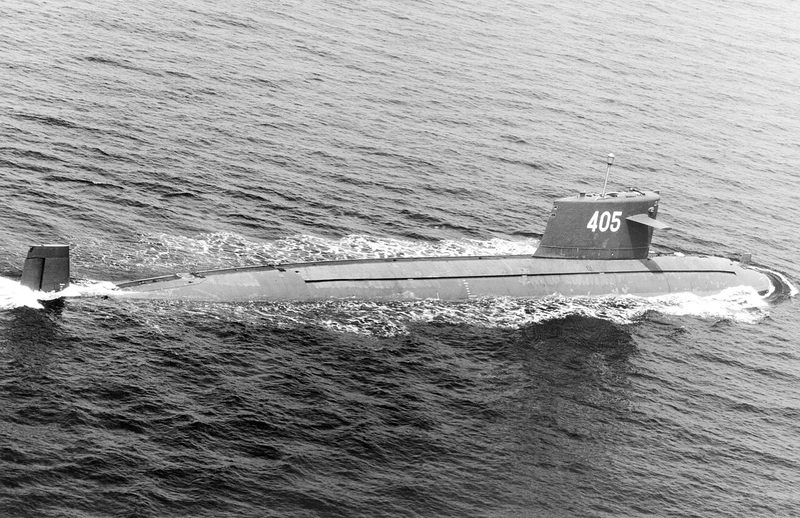
A nuclear submarine is powered by a nuclear reactor and can sail underwater for long periods, making it an important part of a country's strategic deterrent. On the eve of New China's founding, the first naval unit of the People's Liberation Army, the East China Military Region Navy, was established at Baimamiao in Taizhou, Jiangsu, and the People's Navy was born. To break the superpowers' nuclear monopoly and blackmail, in 1958 the Party Central Committee approved development of a missile nuclear submarine. In 1959 Khrushchev refused to give China technical assistance on nuclear submarines, and Mao Zedong said firmly: "Nuclear submarines, even if it takes ten thousand years, we must build them!" Researchers represented by Peng Shilu and Huang Xuhua, with no blueprints and no materials, started from zero and relied on their own efforts, doing their calculations with abacuses and slide rules. In December 1970 China's first nuclear submarine was launched at Huludao, Liaoning. On 1 August 1974 it was named Long March 1 and formally handed over to the Navy, making China, after the United States, the Soviet Union, Britain and France, the fifth country with nuclear submarines. In 1988 China's nuclear submarine successfully completed an extreme-depth dive test and an underwater rocket launch test. Huang Xuhua lived anonymously for thirty years, is hailed as the "father of China's nuclear submarines," and received the Medal of the Republic in 2019. The success strengthened China's national defense and its strategic deterrence at sea. Long March 1 was retired in 2013 and is now on display at the PLA Navy Museum.
References
Text and images from Wikipedia are used under CC BY-SA and their respective licenses