People's Republic of China1949–present
Pingjin Campaign and Peaceful Liberation of Beiping
November 1948–January 1949
In late 1948 the Northeast Field Army and North China forces launched the Pingjin Campaign, taking Tianjin and peacefully liberating Beiping, destroying or reorganizing over 520,000 Kuomintang troops.
View on the timeline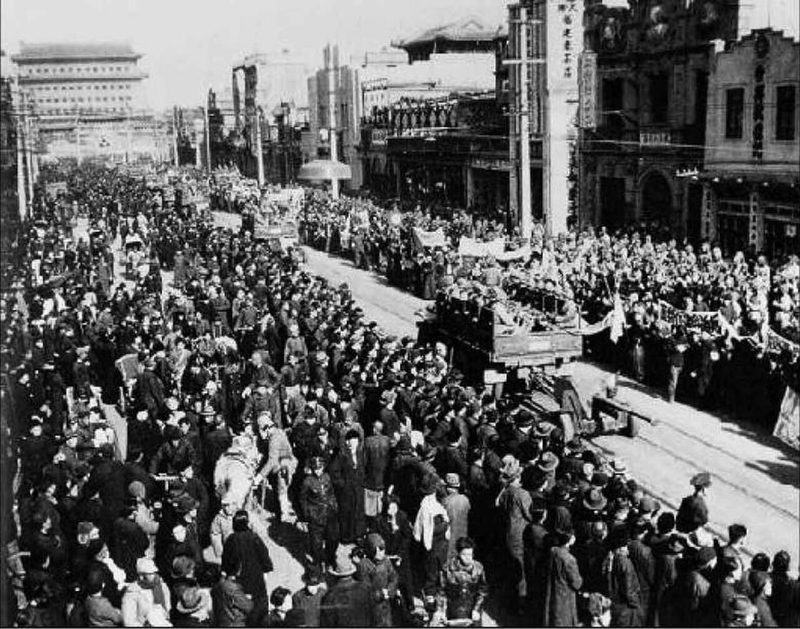
Almost at the same time as the Huaihai Campaign, the Northeast Field Army entered the Great Wall passes and, with the North China People's Liberation Army, launched the Pingjin Campaign. At the time over 500,000 troops under Fu Zuoyi, commander of the Kuomintang North China Bandit-Suppression headquarters, were spread along the line of Beiping, Tianjin, Zhangjiakou and Tanggu, intending to hold on or withdraw south by sea. The campaign began on 29 November 1948. The Liberation Army followed a policy of "isolating without surrounding" and "surrounding without attacking," first encircling Zhangjiakou and Xinbao'an. In late December it took Xinbao'an and Zhangjiakou, destroying Fu Zuoyi's main force of loyal troops. On 14 January 1949 the Liberation Army launched a general assault on the Tianjin garrison, which had refused to surrender, and after 29 hours of fierce fighting took the city, wiping out over 130,000 defenders and capturing Chen Changjie, the Tianjin garrison commander. With Tianjin liberated, the 200,000-plus garrison in Beiping was in an impossible position and Fu Zuoyi accepted terms of peaceful reorganization. On 31 January the Liberation Army entered Beiping, which was peacefully liberated. The peaceful liberation spared the historic and cultural city from the ravages of war and created the "Beiping model" of peacefully resolving the problem of remaining Kuomintang forces. The Pingjin Campaign lasted 64 days and destroyed or reorganized over 520,000 Kuomintang troops, largely liberating North China. The three campaigns together lasted 142 days and destroyed or reorganized over 1.54 million Kuomintang troops, essentially wiping out the main military force on which the Kuomintang's rule depended and greatly hastening nationwide victory. The Pingjin Campaign Memorial Hall stands in Tianjin.
References
Text and images from Wikipedia are used under CC BY-SA and their respective licenses