Republic of ChinaAD 1912–1949
Seventh National Congress of the CCP
April–June 1945
Meeting in Yan'an from April to June 1945, the CCP's Seventh National Congress made Mao Zedong Thought its guide and set the goal of defeating Japan and building a new China.
View on the timeline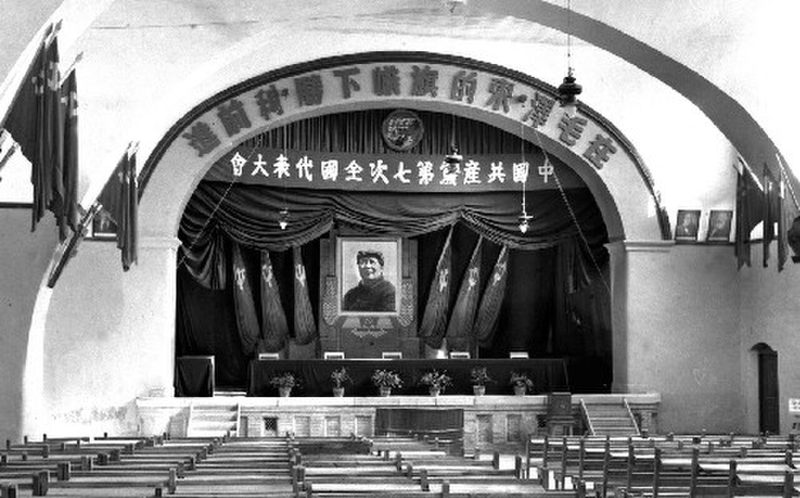
In 1945, with final victory in the War of Resistance approaching, China faced a choice between two futures, bright or dark. From 23 April to 11 June 1945 the Chinese Communist Party held its Seventh National Congress at Yangjialing in Yan'an, attended by over 700 delegates and alternate delegates representing more than 1.2 million Party members. Mao Zedong gave the political report On Coalition Government, Zhu De the military report On the Battlefields of the Liberated Areas, and Liu Shaoqi the report on revising the Party constitution. The congress summed up the twists and turns of more than twenty years of the Party's leadership of the democratic revolution and set the political line of "boldly mobilizing the masses and expanding the people's forces, so that under the Party's leadership we defeat the Japanese aggressors, liberate the whole people and build a New Democratic China." It adopted a new Party constitution establishing Mao Zedong Thought as the Party's guiding ideology and writing it into the constitution. It summed up the three fine styles of work formed in the Party's long revolutionary struggle: integrating theory with practice, maintaining close ties with the masses, and practicing self-criticism. It elected a new Central Committee headed by Mao Zedong. Called the "Congress of Unity and Victory," it laid the political, ideological and organizational foundation for final victory in the War of Resistance and for the nationwide victory of the New Democratic Revolution. The congress site at Yangjialing, Yan'an, is now a major national cultural heritage site.
References
Text and images from Wikipedia are used under CC BY-SA and their respective licenses