Republic of ChinaAD 1912–1949
Chinese Soviet Republic Provisional Government
Winter 1931
In November 1931 the First National Soviet Congress met at Ruijin and set up the Provisional Central Government of the Chinese Soviet Republic, with Mao Zedong as chairman.
View on the timeline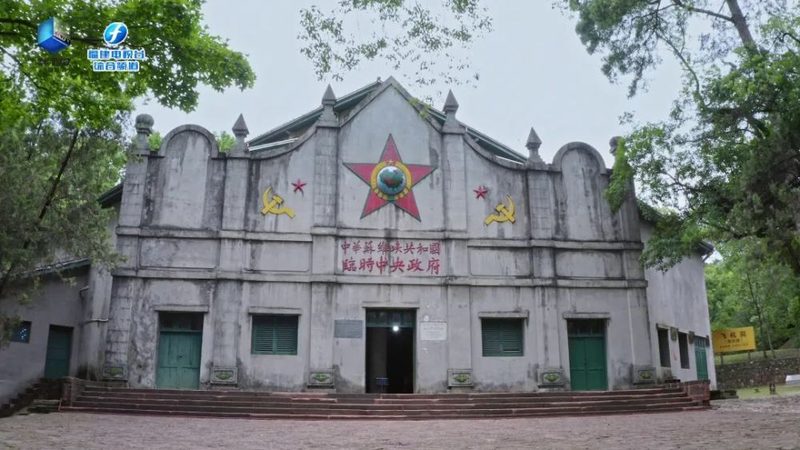
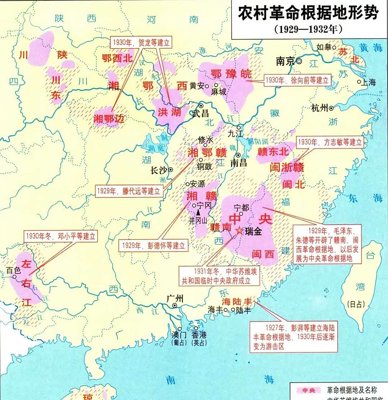
In 1930–1931 soldiers and civilians of the Central Revolutionary Base, under Mao Zedong and Zhu De, defeated three large Kuomintang “encirclement and suppression” campaigns in a row, and the base grew and consolidated. Meanwhile other bases, including the Hubei–Henan–Anhui, Hunan–Hubei–Western Hunan, Fujian–Zhejiang–Jiangxi and Hunan–Jiangxi bases, also developed. To build a unified national Red regime, the First National Congress of Chinese Soviets met at Yeping, Ruijin, Jiangxi, on 7 November 1931. It announced the founding of the Provisional Central Government of the Chinese Soviet Republic, with Ruijin as its capital, and elected Mao Zedong chairman of the Central Executive Committee and of the Council of People's Commissars, Xiang Ying and Zhang Guotao vice-chairmen, and Zhu De chairman of the Central Revolutionary Military Commission. The congress adopted the Constitutional Outline of the Chinese Soviet Republic, which defined it as a state of the democratic dictatorship of workers and peasants. The provisional government set up ministries and commissions, founded a state bank, issued currency and carried out economic, cultural and educational work. This was the Communist Party's first attempt at governing in part of the country, and it gave valuable experience for later building people's government. Under its leadership land revolution was carried out in the Soviet areas, peasants received land and their enthusiasm for production rose greatly, and officials were honest and public-spirited: “Good Soviet cadres bring their own food to work.” In 1934, after the failure of the Fifth Encirclement Campaign, the Central Red Army was forced to begin the Long March and the government left Ruijin.
References
Text and images from Wikipedia are used under CC BY-SA and their respective licenses