Republic of ChinaAD 1912–1949
Provisional Constitution of the Republic of China
11 March 1912
In March 1912 Sun Yat-sen promulgated the Provisional Constitution, vesting sovereignty in the people and setting up separation of powers and a responsible cabinet.
View on the timeline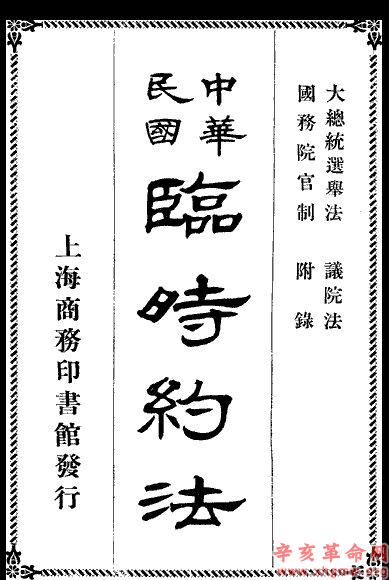
After Sun Yat-sen resigned as provisional president, the Nanjing Provisional Senate hurried to draw up a constitutional charter to consolidate the revolution's gains and guard against dictatorship by Yuan Shikai. On 11 March 1912 Sun, in the name of provisional president, promulgated the Provisional Constitution of the Republic of China drawn up by the Senate. It provided that sovereignty belonged to all citizens; that citizens were equal regardless of race, class or religion; that they enjoyed freedom of person, residence, property, speech, publication, assembly, association, correspondence and belief; and that the territory of the Republic comprised the twenty-two provinces, Inner and Outer Mongolia, Tibet and Qinghai. For the form of government it adopted the bourgeois principle of separation of powers: the Senate exercised legislative power, the provisional president and cabinet ministers executive power, and the courts judicial power. To limit Yuan's power, it changed the originally planned presidential system into a responsible cabinet system, requiring a minister's countersignature for the president's laws and orders to take effect, and giving the Senate power to impeach the president. As fundamental law it affirmed bourgeois democratic republicanism and rejected feudal monarchical autocracy, and so had anti-feudal, progressive significance. But it had clear limitations: it set no anti-imperialist task and did not address the land question. Later, to establish a dictatorship, Yuan abolished it in 1914 and issued the Constitutional Compact of the Republic of China, while Sun launched the “Constitutional Protection Movement” to defend it.
References
Text and images from Wikipedia are used under CC BY-SA and their respective licenses