Republic of ChinaAD 1912–1949
Qing Abdication and Yuan Shikai Seizes Power
February–April 1912
On 12 February 1912 the child emperor Puyi abdicated and the Qing fell; Sun Yat-sen resigned, the Senate elected Yuan Shikai provisional president, and in April the government moved to Beijing.
View on the timeline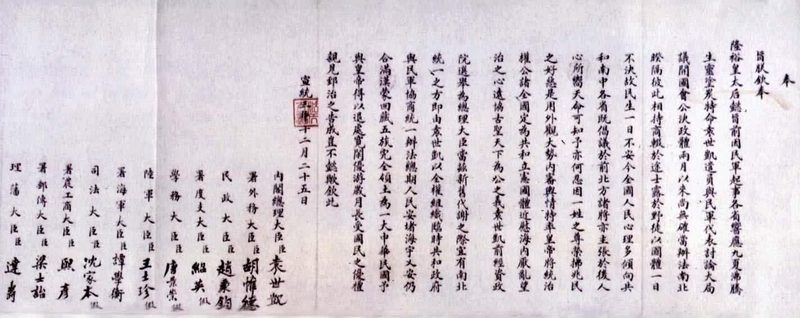
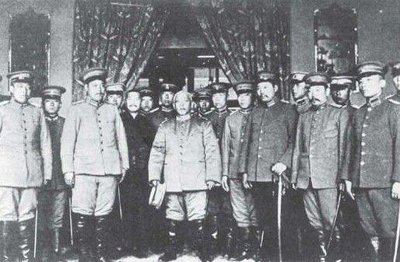
After the Wuchang Uprising broke out, the Qing government recalled the dismissed Yuan Shikai as Prime Minister of the Cabinet, giving him control of military and political power. Yuan sent the Beiyang Army to attack Wuhan, taking Hankou and Hanyang, while negotiating peace with the revolutionaries with the backing of the foreign powers. After the Nanjing Provisional Government was founded, it faced pressure from the imperialist powers and financial trouble, and constitutional monarchists and old officials within the revolutionary camp also urged compromise with Yuan. Sun Yat-sen was forced to say that if the emperor abdicated and Yuan declared support for the republic, he would resign and recommend Yuan as provisional president. Yuan then pressed the court and had Beiyang generals such as Duan Qirui jointly telegraph a demand for abdication. On 12 February 1912, Empress Dowager Longyu issued the abdication edict in the name of the Xuantong Emperor, Puyi; the Qing dynasty came to an end, and with it the monarchy of over two thousand years. The next day Sun resigned to the Senate, attaching conditions in an attempt to restrain Yuan: the provisional government must stay in Nanjing, the new president must take office in Nanjing, and he must abide by the Provisional Constitution. On 15 February the Senate elected Yuan provisional president. Citing unrest in the north, Yuan refused to go south. On 10 March he was sworn in at Beijing. In April Sun formally stepped down and the provisional government moved to Beijing. China then entered the era of Beiyang warlord rule. Yuan's seizure of the fruits of the revolution showed that the Xinhai Revolution had not completed its anti-imperialist and anti-feudal tasks, and China's semi-colonial, semi-feudal character was unchanged.
References
Text and images from Wikipedia are used under CC BY-SA and their respective licenses