QingAD 1644–1912
Taiwan’s Armed Resistance against Japan
May–October 1895
After the Qing ceded Taiwan in 1895, troops and civilians under Liu Yongfu, Xu Xiang and others resisted Japan for nearly five months in over a hundred battles, dealing the invaders heavy blows.
View on the timeline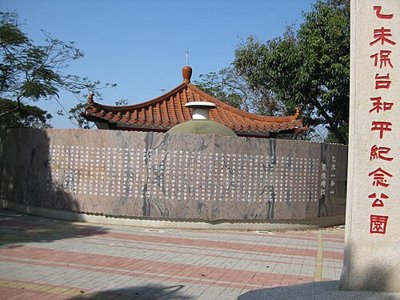
When news of the Treaty of Shimonoseki reached Taiwan, its people were filled with grief and swore never to be subjects of a conquered country. Taiwan gentry such as Qiu Fengjia petitioned in blood, declaring that “our native land will live or die with righteousness.” In May 1895 Japan landed the Imperial Guard Division and other forces in northern Taiwan and began to seize it by force. Short of pay and arms and with no outside help, Taiwan’s troops and civilians resisted stubbornly. After taking Keelung the Japanese occupied Taipei. The people formed volunteer forces and fought fierce battles with the Japanese at Hsinchu, Miaoli, Changhua and elsewhere. Volunteer leaders Xu Xiang, Wu Tangxing, Jiang Shaozu and others fought bravely and repeatedly hurt the Japanese. In August, when the Japanese attacked Changhua, Wu Tangxing and others died heroically in the Battle of Baguashan. Liu Yongfu’s Black Flag Army then held Tainan, fighting alongside the volunteers. In October Xu Xiang was gravely wounded and, dying, cried out, “A man who dies for his country has no regret!” With supplies exhausted and no relief, Liu Yongfu crossed to the mainland in late October and Tainan fell. From May to October, Taiwan’s troops and civilians fought over a hundred battles with the Japanese, inflicting thousands of casualties, and the Japanese division commander Prince Kitashirakawa Yoshihisa died of illness in Taiwan. The resistance did not end there: during fifty years of Japanese colonial rule, Taiwanese kept resisting, as in the 1915 Xilaian Incident and the 1930 Wushe Incident. Their struggle showed the unyielding patriotic spirit of the Chinese nation. After victory in the War of Resistance in 1945, Taiwan returned to China.
References
Text and images from Wikipedia are used under CC BY-SA and their respective licenses