QingAD 1644–1912
Portugal Gradually Takes Over Macao
1844–1887
After the Opium War Portugal gradually took control of Macao, and in 1887 forced the Qing into a treaty granting Portugal “perpetual occupation and government” of Macao.
View on the timeline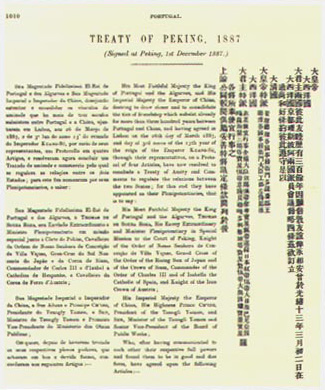
Since the Portuguese were allowed to live in Macao in 1553, sovereignty over Macao had always belonged to China; the Portuguese paid ground rent to the Chinese government each year, and China kept officials there to govern and collect taxes. After the Opium War Portugal sought to take over administration, turning from residents into rulers. In 1844 the Portuguese government ignored China’s sovereignty and announced an “overseas province” made up of Macao, Timor and other places, and in 1845 unilaterally declared Macao a free port. In 1846 Governor João Maria Ferreira do Amaral took office, imposed colonial rule, forced Macao’s Chinese residents to pay taxes, from 1849 stopped paying ground rent to China and expelled Chinese officials, arousing strong local anger. In August 1849 Amaral was assassinated by local youths including Shen Zhiliang. Portugal then occupied Wangxia and other villages in northern Macao, and the islands of Taipa and Coloane. In 1887, using China’s need for cooperation in collecting opium duties, Portugal forced the Qing to sign the Sino-Portuguese Treaty of Friendship and Commerce, which stated that “Portugal shall perpetually occupy and govern Macao and its dependencies, as with any other Portuguese possession,” and that Portugal could not cede Macao to a third country without China’s consent, with the boundaries to be surveyed later. Portugal thus gained “perpetual occupation and government” of Macao, but its boundaries were never formally set. Portugal ruled Macao as a colony for over a hundred years. On 20 December 1999 China resumed sovereignty over Macao and the Macao Special Administrative Region was established.
References
Text and images from Wikipedia are used under CC BY-SA and their respective licenses