QingAD 1644–1912
Founding of the Tongwen Guan
1862
In 1862 the Qing opened the Tongwen Guan (School of Combined Learning) in Beijing to train interpreters, later adding astronomy and mathematics; it was China’s first state-run modern school.
View on the timeline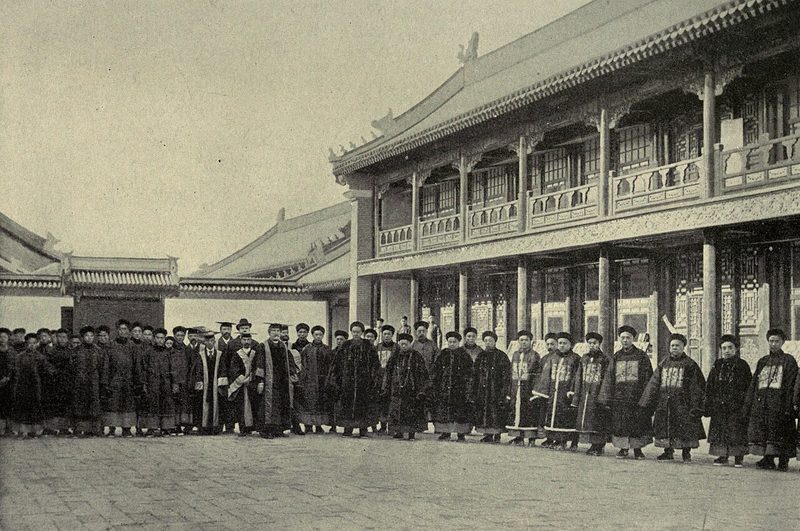
After the Second Opium War the Qing’s dealings with foreigners grew, and because of “language barriers and difficult writing,” it urgently needed foreign-language experts. When Prince Gong Yixin asked to set up the Zongli Yamen, he also proposed a school to teach foreign languages. In 1862 the Tongwen Guan opened in Beijing, at first with only an English section, later adding French, Russian, German and Japanese. It first admitted Banner youths under fourteen, later also Manchu and Han juren and officials of the fifth rank and below from regular backgrounds. In 1866 Yixin proposed adding an astronomy and mathematics department; Grand Secretary Woren and other conservatives fiercely opposed it, holding that “the way to build a state lies in propriety and righteousness, not in scheming,” but it was still set up. The curriculum then widened to chemistry, physics, international law, medicine, astronomy, geography, foreign history and geography and political economy. Foreigners taught there, with the American missionary William Martin long serving as head instructor. The course lasted eight years (with a five-year option), and top students could receive official posts. The school also had a press that translated and published Western books such as the Chemistry Guide and Political Economy, and trained diplomats and translators; many graduates became envoys and diplomatic officials. The Tongwen Guan was China’s first state-run modern school and pioneered modern education in China. In 1902 it was merged into the Imperial University of Peking.
References
Text and images from Wikipedia are used under CC BY-SA and their respective licenses