QingAD 1644–1912
Closed-Door Policy and the Canton System
1757
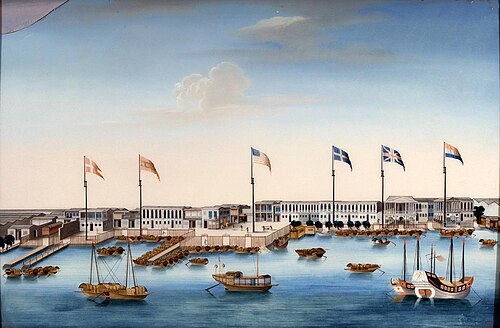
Under the Qing closed-door policy, the Qianlong Emperor ruled in 1757 that Western merchants could trade only at Guangzhou, through the licensed “Thirteen Hongs,” under tight restrictions.
View on the timeline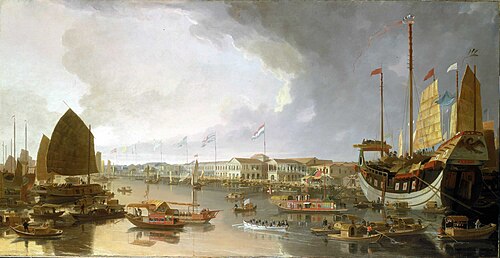
Qing rulers believed the Celestial Empire was rich in products and had no need for economic exchange with foreign countries. At the same time, Western colonial powers were expanding eastward, and the Qing feared for its sovereignty and worried that contact between coastal people and foreigners would endanger its rule. It therefore adopted a “closed-door” policy that strictly limited foreign trade. Under the Shunzhi Emperor, to cut off support for anti-Qing forces such as Zheng Chenggong, a “sea ban” was issued and coastal residents were forced to move 30 to 50 li inland. After Taiwan was unified in 1683 the ban was lifted, and customs offices were set up in Guangdong, Fujian, Zhejiang and Jiangsu. In 1757 the Qianlong Emperor closed the Fujian, Zhejiang and Jiangsu offices and allowed Western merchants to trade only at Guangzhou, where the government-licensed “Thirteen Hongs” managed all foreign trade. Foreign merchants had to live in the trading factories at Guangzhou and could not come and go freely, had to leave when the trading season ended, and were forbidden to hire Chinese servants, learn Chinese or buy Chinese books. In 1793 Britain sent the Macartney Mission, asking for more open ports and the cession of islands; the Qianlong Emperor refused. For a time the policy served as a defense against Western colonial aggression, but it obstructed economic and cultural exchange, hindered the growth of capitalist sprouts, and kept China blind to changes in the world. China gradually fell behind, which ultimately contributed to its defeats in modern times.
References
Text and images from Wikipedia are used under CC BY-SA and their respective licenses