QingAD 1644–1912
Kangxi Suppresses Galdan's Rebellion
Reign of Kangxi
Galdan of the Dzungars rebelled with Russian backing; the Kangxi Emperor campaigned three times, crushing him at Ulan Butong and Zuunmod, and the northern frontier was secured.
View on the timeline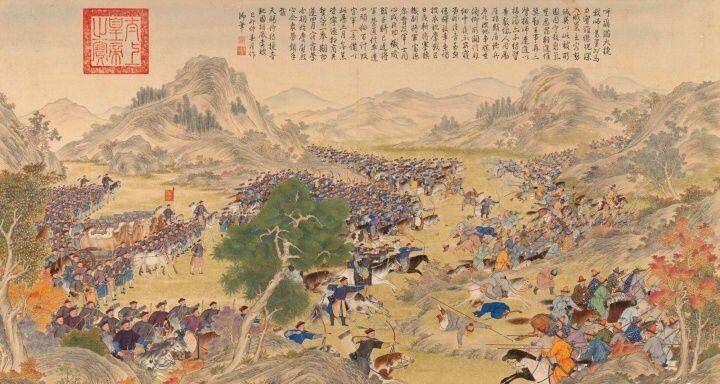
The Qing divided the Mongols into three main groups: southern Mongolia, northern (Khalkha) Mongolia and western (Oirat) Mongolia. In the late 17th century the Dzungars among the western Mongols grew strong and their leader Galdan, ambitious and supported and incited by Russia, absorbed the western Mongol tribes and crossed the Tianshan to take the Muslim oasis cities, controlling both sides of the Tianshan. In 1688 Galdan attacked the northern Khalkha Mongols, who were forced south and asked for Qing protection. In 1690, claiming to pursue the Khalkha, Galdan advanced into southern Mongolia as far as Ulan Butong (in present-day Hexigten Banner, Inner Mongolia), only seven hundred li from Beijing. The Kangxi Emperor led the army in person, and the Qing broke Galdan's "camel fortress" of camels with cannon and defeated the rebels, and Galdan fled with his remnants. In 1691 the emperor held an assembly with the Khalkha leaders at Dolon Nor and introduced the league-and-banner system in northern Mongolia, strengthening control over it. In 1696 Galdan invaded again; the Kangxi Emperor campaigned in person in three columns, and the General Who Pacifies the Distant, Fiyanggu, crushed Galdan's army at Zuunmod (south of present-day Ulaanbaatar, Mongolia), where Galdan's wife also fell in battle. In 1697 the emperor went on his third campaign; Galdan, abandoned by his followers and with nowhere to turn, soon died. The three campaigns put down Galdan's rebellion, preserved unity and secured the northern frontier. But Dzungar separatism did not end, and not until the Qianlong reign did the Qing finally pacify the Dzungars and unify the lands north and south of the Tianshan.
References
Text and images from Wikipedia are used under CC BY-SA and their respective licenses